A sermon preached to Holy Trinity Anglican Church in Yellowknife, NT. The congregation is working through The Story in place of the regular lectionary, having read through large portions of Ezra-Nehemiah together in discipleship groups this week.
As we return to The Story this week, we’re struck with the great work of rebuilding. God not just allowed, but actually sent his people into exile, so that they would learn to trust in him once more. In exile, through the harsh realities of life, they learned to be people of faith. Then, in spite of incredible circumstances, in spite of persecution and injustice, in spite of outright diabolical plans to exterminate them, by faith they received the promise of God.
By faith, they saw with their own eyes that God kept his word; and, against all odds, God returned them to their promised land, equipped with all the tools and resources they needed to rebuild.
A Time of Reconstruction
All this week, I’ve been reflecting and meditating on this idea of rebuilding.
I firmly believe that we Christians find ourselves, here today, in a period of God-given reconstruction. Across the board, our witness in the world is confused and divided.
Certainly, for this church, as we look to how we’ve done in passing the faith from one generation to another and making new disciples in our city, we see the need to enter a long period of rebuilding.
But it’s even bigger than that.
Because, as much as televangelists and old-fashioned revivals might tell us different, faith isn’t just a personal matter.
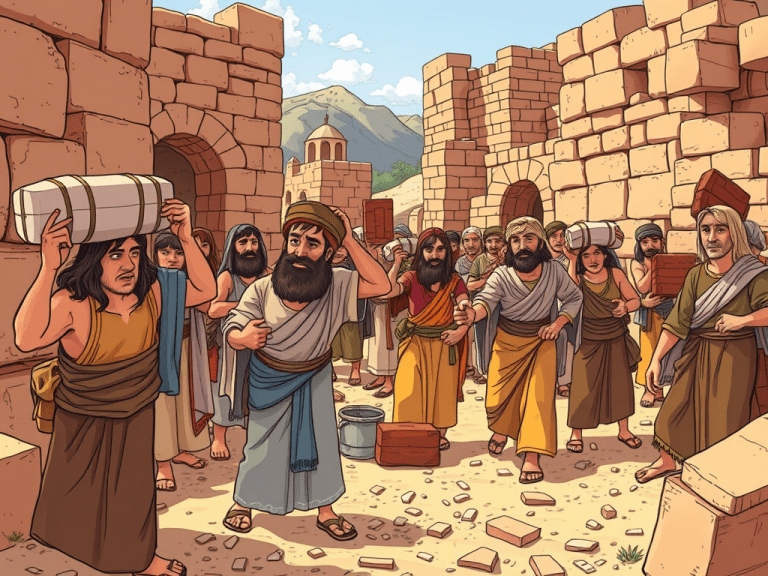
For God’s people, amazingly returned to the promised land with all that they need having been provided, it’s not just houses or city walls that need to be rebuilt. The entire community needs rebuilding; the way people think, the way people care, the way people relate to one another all needs to be built up out of the rubble.
That was true in the days of Ezra and Nehemiah, and I firmly believe it’s true today.
Thanks be to God: we don’t have the physical destruction that requires physical rebuilding. But let’s be honest: we, as a community, as Christians gathered here today, we feel pretty low, pretty tired, pretty worn out.
As a congregation, we’ve lost much over our history. The glory of former years has passed away – full pews, a full Sunday School, being a gathering place for the key families in the community, the picture in the porch of the Queen herself coming to visit – that’s not our reality anymore. Good people have retired and moved away, and no one has come in to take their place; clergy come and go, none sticking around long enough to raise up a strong generation; friends get sick and life wears us down; this past year, too many of those who shared the pews with us have gone unexpectedly to be with the Lord. It’s a lot.
Nobody’s in the mood for rebuilding. We’re tired and worn down. This never-ending series of events has taken its toll.
But for me, one thing is clear: we can’t just “keep on truckin’”. (That’s the message of Lent too, isn’t it?) When the path you’re on is leading nowhere good, the answer isn’t to just keep putting one foot in front of the other.
The truth is that most of us have experienced chronic low-grade trauma since Covid.
If we had experienced all of this at once, we’d be utterly broken. But, as often happens with chronic traumatic experiences, the damage is done a bit at a time. On the one hand that makes it manageable, or at least sort-of. We learn to adapt with the terrible situations a little bit at a time. The down side, however, is that we end up accepting the situation as “normal”; as a coping mechanism, we end up lowering the bar for what it feels like to be healthy and happy with each new traumatic experience. Finally our bodies and our spirits and our hearts are telling us that something is terribly wrong, but our minds are trying to convince us that the situation we’re in is “normal”.
We, our church, our community, our nation, needs to acknowledge the mess we’re in; and we don’t need to patch things up… we need to rebuild.
God’s Plan for Trauma-Informed Reconstruction
Thanks be to God, scripture gives us a plan for trauma-informed reconstruction. It took science a thousand years to finally realize that trauma has an effect on the human person, but, not surprisingly, we read about it back in the books of Ezra and Nehemiah!
Now, I know what you might be thinking: yes, we know we’re at a turning point as a church if we want to get serious about mission and ministry over the next 15, 25, or 50 years… but we don’t have the energy to rebuild!
But this is what we can learn from Ezra and Nehemiah. You’ll remember that the people were divided. They came into Jerusalem and realized it was a heap of rubble. The youth – the new-comers – celebrated at the opportunity to rebuild, while the elders – the lifers – wept at all that had been lost. Perhaps that sounds familiar? This division became a barrier to moving forward, because everyone was concerned with their own interests.
But God’s solution was for people to see the bigger picture, to see themselves as one family, one body, where the stronger support the weaker, where one shares memories to encourage the other, and where all realize that they need the other: that, in spite of the disagreements or weakness or sadness or pain, they are better together than they could ever be on their own.
And finally, once they are united, we see what I believe is a biblical pattern for moving forward through the pain and trauma and change.
1. Do what you can do.
When Nehemiah set out to rebuild the walls, he ordered everyone to start carrying stones. But what did he quickly realize? Not everyone is called to do the same work.
Some were energized, strong, tired of being idle, and finding themselves in trouble because they didn’t have enough to do. They needed to get to work.
But, through no fault of their own, others weren’t able to carry stones. They were anxious, as rumors of wars circled around them; they were weakened by years of exile and division. They became the defenders of the community.
Now, what sort of defenders do we need in our rebuilding? We need those who watch out for us, ensuring we’re taking care of ourselves. We need those who can offer a word of encouragement, or just put on a pot of tea and share the sort of personal contact we all need to re-learn as we – Holy Trinity – are knit together for the future of all that God wants to accomplish through us in this city and beyond.
But that’s huge: like the people of Israel, in our own rebuilding, we need to learn that it’s ok for different people to be called to be involved in different ways, as long as we’re supporting one another, following where Jesus leads.. Some move bricks, some care for and watch out for those who are moving bricks; all together, God uses his people to rebuild their community.
2. Read the Bible.
I’m struck in today’s lesson just how seriously they take the word of God. Before the exile God sent prophet after prophet, but no one cared. At best they smiled and nodded, they said ‘I’m spiritual, not religious: I like to have my Baal statue and my Ashtoreth pole, since there’s many paths to God’. It wasn’t until their society collapsed that God’s people realized that they weren’t taking him seriously.
As we rebuild and refocus our mission and ministry, our God-given task of evangelism and discipleship, we need to be serious about the Bible.
Not to beat people over the head with it. Certainly not. But to submit ourselves to it. To acknowledge that it’s primary message is that I’m wrong, I need God, I can’t do it on my own, and that our one and only hope in life and death is that we are not alone but belong to God. That’s our message. And yes, that sort of dependence is utter foolishness to many in the world around us… until it isn’t. Until it finally clicks, when their eyes are opened and they see how the last thing we really need is to be left to our own devices to continue down a path of our own choosing. What we need is to trust in the one who keeps his promises, who can do more than we can ask or imagine when we put our trust in Him.
3. Tune out those seeking their own good.
This is a tough one. Remember when Nehemiah was rebuilding the walls? The governors of the surrounding nations sent him letter after letter, they would send messengers and drop by unannounced… to do what?
To discourage.
Why were they set on discouraging God’s people? Because they were profiting from the mess the world was in.
This is a big one… and it’s a hard one. Part of trusting in God, in being serious about his Word, is learning to tune out those who are seeking their own good. This requires gentleness, wisdom, and a lot of discernment, so I say it cautiously, but scripture shows that even the best of us can find ourselves focusing on comfort and familiarity – what feels best for us – rather than the work set in front of us. We’re all at risk of that.
Nehemiah, it says, simply ignored the letters. That’s easier said than done, isn’t it!
But part of the work of rebuilding means learning that, if something is really true and founded on God’s Word, we don’t need to justify it, or argue about it. We can simply rely on that which is true, and let those discouraging voices wear themselves out.
Again, this is where it’s important to have those defenders – those people in the family of the church who are encouraging and supporting and making a cup of tea for those who need it!
4. Be Doers of the Word
Finally, as we learn from the Letter of James, we need to be doers of the word, not just hearers. The work of rebuilding our church for the generations to come, refocusing our mission and ministry to reach those who are not yet in the room means that we hear God’s Word and then do it.
We hear our need of repentance, so we repent.
We hear our own need for forgiveness, so we offer it to others, lavishly and with patience, again and again, 70 times 7 times if that’s what it takes.
We hear the message – not that we’ve got it all together, but that we need to bind the broken, to build up those who feel beat down, and to call the world into a relationship with God and ourselves, so that all the nations can be blessed through us. So we do it.
For some of us, that means getting serious about the calling that God has on your life for ministry. For most of us, that means being serious about #1 – doing what you can do. If you can’t do the heavy lifting of rebuilding and refocusing the ministry of the church to those who are outside, encourage those who can. If the only load you can carry right now is to boil the kettle, pick up the phone, and invite someone over for a chat, do what you can do. You never know, the person who looks busiest might really be longing for that invitation, and in need of some friendship and support themselves!
Be Part of What God is doing!
If we look at the mission of the church in our day, we’ll agree: we’re entering a time of rebuilding.
Yes, we need to acknowledge all that has changed, all that’s been lost: the glory and pride and full pews and full Sunday School and full list of able-bodied volunteers of former years, the friends lost, the constant feeling of two-steps forward and one step back. We need to acknowledge that, but we also need to push back against lowering the bar of what is healthy, what is good, not to place demands on others, but to work together to rebuild a community that is supportive for us all, from the ground up.
God will build his Church.
For we know he keeps his promises. With him all things are possible, and if we trust him, he’ll accomplish in us, weak as we are, far more than we can ask or imagine.
To God be the glory now and forevermore. Amen.
 Bishop Alexander Pryor