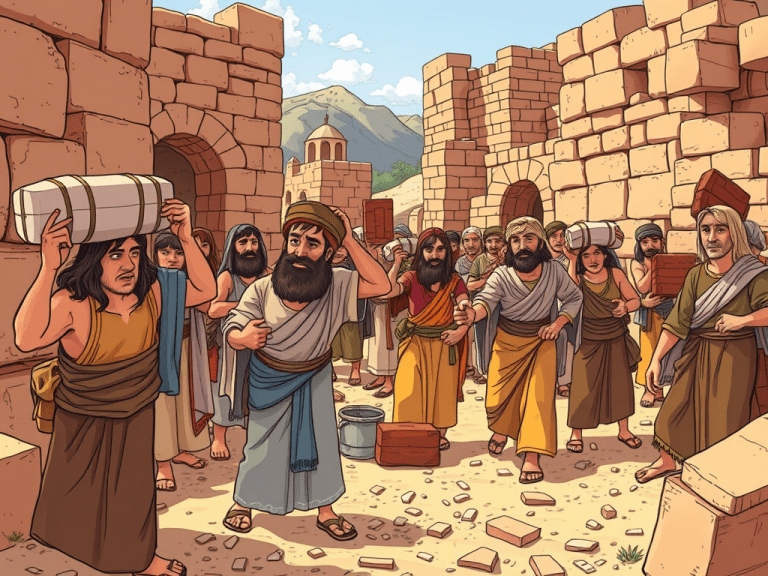
A time for re-construction

A sermon preached to Holy Trinity Anglican Church in Yellowknife, NT. The congregation is working through The Story in place of the regular lectionary, having read through large portions of Ezra-Nehemiah together in discipleship groups this week.

As we return to The Story this week, we’re struck with the great work of rebuilding.  God not just allowed, but actually sent his people into exile, so that they would learn to trust in him once more.  In exile, through the harsh realities of life, they learned to be people of faith.  Then, in spite of incredible circumstances, in spite of persecution and injustice, in spite of outright diabolical plans to exterminate them, by faith they received the promise of God.

By faith, they saw with their own eyes that God kept his word; and, against all odds, God returned them to their promised land, equipped with all the tools and resources they needed to rebuild.

A Time of Reconstruction

All this week, I’ve been reflecting and meditating on this idea of rebuilding. 

I firmly believe that we Christians find ourselves, here today, in a period of God-given reconstruction.  Across the board, our witness in the world is confused and divided.

Certainly, for this church, as we look to how we’ve done in passing the faith from one generation to another and making new disciples in our city, we see the need to enter a long period of rebuilding.

But it’s even bigger than that.

Because, as much as televangelists and old-fashioned revivals might tell us different, faith isn’t just a personal matter. 

For God’s people, amazingly returned to the promised land with all that they need having been provided, it’s not just houses or city walls that need to be rebuilt.  The entire community needs rebuilding; the way people think, the way people care, the way people relate to one another all needs to be built up out of the rubble.

That was true in the days of Ezra and Nehemiah, and I firmly believe it’s true today.

Thanks be to God: we don’t have the physical destruction that requires physical rebuilding.  But let’s be honest: we, as a community, as Christians gathered here today, we feel pretty low, pretty tired, pretty worn out.

As a congregation, we’ve lost much over our history.  The glory of former years has passed away – full pews, a full Sunday School, being a gathering place for the key families in the community, the picture in the porch of the Queen herself coming to visit – that’s not our reality anymore. Good people have retired and moved away, and no one has come in to take their place; clergy come and go, none sticking around long enough to raise up a strong generation; friends get sick and life wears us down; this past year, too many of those who shared the pews with us have gone unexpectedly to be with the Lord.  It’s a lot.

Nobody’s in the mood for rebuilding.  We’re tired and worn down.  This never-ending series of events has taken its toll. 

But for me, one thing is clear: we can’t just “keep on truckin’”.  (That’s the message of Lent too, isn’t it?) When the path you’re on is leading nowhere good, the answer isn’t to just keep putting one foot in front of the other.

The truth is that most of us have experienced chronic low-grade trauma since Covid. 

If we had experienced all of this at once, we’d be utterly broken.  But, as often happens with chronic traumatic experiences, the damage is done a bit at a time.  On the one hand that makes it manageable, or at least sort-of.  We learn to adapt with the terrible situations a little bit at a time.  The down side, however, is that we end up accepting the situation as “normal”; as a coping mechanism, we end up lowering the bar for what it feels like to be healthy and happy with each new traumatic experience. Finally our bodies and our spirits and our hearts are telling us that something is terribly wrong, but our minds are trying to convince us that the situation we’re in is “normal”.

We, our church, our community, our nation, needs to acknowledge the mess we’re in; and we don’t need to patch things up… we need to rebuild.

God’s Plan for Trauma-Informed Reconstruction

Thanks be to God, scripture gives us a plan for trauma-informed reconstruction. It took science a thousand years to finally realize that trauma has an effect on the human person, but, not surprisingly, we read about it back in the books of Ezra and Nehemiah!

Now, I know what you might be thinking: yes, we know we’re at a turning point as a church if we want to get serious about mission and ministry over the next 15, 25, or 50 years… but we don’t have the energy to rebuild! 

But this is what we can learn from Ezra and Nehemiah.  You’ll remember that the people were divided.  They came into Jerusalem and realized it was a heap of rubble. The youth – the new-comers – celebrated at the opportunity to rebuild, while the elders – the lifers – wept at all that had been lost.  Perhaps that sounds familiar?  This division became a barrier to moving forward, because everyone was concerned with their own interests. 

But God’s solution was for people to see the bigger picture, to see themselves as one family, one body, where the stronger support the weaker, where one shares memories to encourage the other, and where all realize that they need the other: that, in spite of the disagreements or weakness or sadness or pain, they are better together than they could ever be on their own.

And finally, once they are united, we see what I believe is a biblical pattern for moving forward through the pain and trauma and change.

1. Do what you can do.

When Nehemiah set out to rebuild the walls, he ordered everyone to start carrying stones.  But what did he quickly realize?  Not everyone is called to do the same work.

Some were energized, strong, tired of being idle, and finding themselves in trouble because they didn’t have enough to do.  They needed to get to work.

But, through no fault of their own, others weren’t able to carry stones.  They were anxious, as rumors of wars circled around them; they were weakened by years of exile and division.  They became the defenders of the community. 

Now, what sort of defenders do we need in our rebuilding?  We need those who watch out for us, ensuring we’re taking care of ourselves.  We need those who can offer a word of encouragement, or just put on a pot of tea and share the sort of personal contact we all need to re-learn as we – Holy Trinity – are knit together for the future of all that God wants to accomplish through us in this city and beyond.

But that’s huge: like the people of Israel, in our own rebuilding, we need to learn that it’s ok for different people to be called to be involved in different ways, as long as we’re supporting one another, following where Jesus leads..  Some move bricks, some care for and watch out for those who are moving bricks; all together, God uses his people to rebuild their community.

2. Read the Bible.

I’m struck in today’s lesson just how seriously they take the word of God.  Before the exile God sent prophet after prophet, but no one cared.  At best they smiled and nodded, they said ‘I’m spiritual, not religious: I like to have my Baal statue and my Ashtoreth pole, since there’s many paths to God’.  It wasn’t until their society collapsed that God’s people realized that they weren’t taking him seriously.

As we rebuild and refocus our mission and ministry, our God-given task of evangelism and discipleship, we need to be serious about the Bible. 

Not to beat people over the head with it.  Certainly not.  But to submit ourselves to it. To acknowledge that it’s primary message is that I’m wrong, I need God, I can’t do it on my own, and that our one and only hope in life and death is that we are not alone but belong to God.  That’s our message.  And yes, that sort of dependence is utter foolishness to many in the world around us… until it isn’t.  Until it finally clicks, when their eyes are opened and they see how the last thing we really need is to be left to our own devices to continue down a path of our own choosing.  What we need is to trust in the one who keeps his promises, who can do more than we can ask or imagine when we put our trust in Him.

3. Tune out those seeking their own good.

This is a tough one.  Remember when Nehemiah was rebuilding the walls?  The governors of the surrounding nations sent him letter after letter, they would send messengers and drop by unannounced… to do what? 

To discourage.

Why were they set on discouraging God’s people?  Because they were profiting from the mess the world was in. 

This is a big one… and it’s a hard one. Part of trusting in God, in being serious about his Word, is learning to tune out those who are seeking their own good. This requires gentleness, wisdom, and a lot of discernment, so I say it cautiously, but scripture shows that even the best of us can find ourselves focusing on comfort and familiarity – what feels best for us – rather than the work set in front of us. We’re all at risk of that.

Nehemiah, it says, simply ignored the letters.  That’s easier said than done, isn’t it!

But part of the work of rebuilding means learning that, if something is really true and founded on God’s Word, we don’t need to justify it, or argue about it.  We can simply rely on that which is true, and let those discouraging voices wear themselves out. 

Again, this is where it’s important to have those defenders – those people in the family of the church who are encouraging and supporting and making a cup of tea for those who need it!

4. Be Doers of the Word

Finally, as we learn from the Letter of James, we need to be doers of the word, not just hearers.  The work of rebuilding our church for the generations to come, refocusing our mission and ministry to reach those who are not yet in the room means that we hear God’s Word and then do it.

We hear our need of repentance, so we repent.

We hear our own need for forgiveness, so we offer it to others, lavishly and with patience, again and again, 70 times 7 times if that’s what it takes.

We hear the message – not that we’ve got it all together, but that we need to bind the broken, to build up those who feel beat down, and to call the world into a relationship with God and ourselves, so that all the nations can be blessed through us.  So we do it. 

For some of us, that means getting serious about the calling that God has on your life for ministry.  For most of us, that means being serious about #1 – doing what you can do.  If you can’t do the heavy lifting of rebuilding and refocusing the ministry of the church to those who are outside, encourage those who can.  If the only load you can carry right now is to boil the kettle, pick up the phone, and invite someone over for a chat, do what you can do.  You never know, the person who looks busiest might really be longing for that invitation, and in need of some friendship and support themselves!

Be Part of What God is doing!

If we look at the mission of the church in our day, we’ll agree: we’re entering a time of rebuilding.

Yes, we need to acknowledge all that has changed, all that’s been lost: the glory and pride and full pews and full Sunday School and full list of able-bodied volunteers of former years, the friends lost, the constant feeling of two-steps forward and one step back. We need to acknowledge that, but we also need to push back against lowering the bar of what is healthy, what is good, not to place demands on others, but to work together to rebuild a community that is supportive for us all, from the ground up.

God will build his Church. 

For we know he keeps his promises.  With him all things are possible, and if we trust him, he’ll accomplish in us, weak as we are, far more than we can ask or imagine. 
To God be the glory now and forevermore.  Amen.

A sleepy gardener?

Mark 4:26-34

How many times do we read in scripture that the good news of the Kingdom of God is like a seed being scattered or a vine or a tree being planted?  After sheep and shepherds, those farming analogies are among the most common in God’s Word.  They’re familiar, they’re accessible, they’re easy enough to understand – and yet, they teach lessons that it can take a lifetime to put into practice.

Gardening Lessons from Jesus.

“The Kingdom of God is as if a man should scatter seed on the ground”; ok, that part is easy enough to understand.  But listen to what comes next: the gardener works hard, waking early and going to bed late, carefully fertilizing the soil and pulling weeds?  Or, does the gardener hire some servants to watch the field, scaring away the ravens and squirrels who come to snatch the seeds for a quick snack?

No.  Look at what comes next: Seeds are scattered on the ground… and “he sleeps and rises night and day; and the seed sprouts and then it grows, but he doesn’t know how.”

This guy plants his seeds… and then what?  He goes to bed!  He gets up the next day and then what?  He goes about his day, and then goes to bed again.  He repeats this, day after day, and then – he doesn’t quite know how – one day, he looks out and, lo and behold, the seeds have turned into plants.  And Jesus says “the Kingdom of God is like that”.  Alright then!  It’s amazing – and there’s a central, but uncomfortableidea here about faith. 

The point that Jesus is making here is one that we hear throughout scripture: faith is a gift from God.[1]  At the end of the day, faith is not something that we can drum up within ourselves.  It isn’t something that we can search out and satisfy, as though if I just learned a few more things or could figure a couple more things out, I would know the answers, I wouldn’t have to trust and believe anymore.  No, faith is a gift.  We can prepare the soil for planting; once the seed has sprouted, we can water it and tend it, support it if it becomes weak, fertilize it to make it fruitful.  But think about it – we can’t make a seed sprout.  The best we can do is stay out of the way and let God give the growth. 

Gifts make us uncomfortable.

Now, unfortunately for us, we’re raised in a culture that isn’t good at receiving gifts.  Children get gifts, and we teach them to say thank you, but as we grow, we’re taught by our families, in our schools, in the workplace, we learn across our society to replace gifts with hard work and earned rewards.  Now don’t get me wrong, I’m not suggesting that’s all bad.  But, as adults in our part of the world, what free gifts do we receive?

We work hard for the things we get – and even if our work offers us a bonus, it’s something we’ve earned, not a gift, right?  Sure, we send cards to one another; we might send some flowers when someone is sick; those who bake might trade their specialities with their friends – dropping off a pie to a friend, who next week brings over a loaf of homemade bread.  But, beyond that, I think most of us are well-trained to be uncomfortable with gifts.  We say “you shouldn’t have”, and sometimes I think we mean it, because now we have to come up with a way to return the favour!

We like to be self-sufficient.  We like to work hard and earn what we have, and sure, we’ll share and be generous out of what we’ve earned, but none of us like the thought of being on the receiving end of someone else’s charity. 

The big message, though, is that if God is our Father, if we truly are his children, if you and I really are Jesus’s baby brother or sister, adopted into God’s family and learning the family values to take up our role in the family business, then we really are like kids on Christmas morning – we need to be able to accept the gifts given freely, given with no expectation for anything but love in return, gifts above and beyond what we could ever muster out of our own strength or savings.

That’s the great message in today’s lesson: the gardener knows that the soil had to be prepared; he knows that plants need water and food and light and nurture.  But the one thing he can’t give the seed is growth.  All that gardener can do is go about his life, go about his days, sleeping and rising, trusting that God will use the soil that was prepared and that, when the time is right, those seeds will sprout, and then that gardener can faithfully tend them as they grow.

Faith, not just belief.

My friends, faith is like that.  More often than not, we need to get out of the way; we need to go about our lives as children of God, one step at a time, one day at a time; we need to lie down and rest, and get up and do what need to be done, but let God give the growth he has in store for each of us.

But it’s hard, isn’t it?  It’s hard to take life one step at a time, to simply go to sleep when night comes, and get up and go where God leads when the next day dawns. 

We like to have a plan; we like to know what the next steps are; we like to know what we have to do to make the next thing happen, because we’re so well trained to want to earn what we have rather than accept it as a gift.

And we’re not alone in that mistake.

Think of Abraham – God told him he would be the father of many nations.  Did Abraham believe what God said?  Yes!  But what did Abraham do next?  He looked at his wife, said, wow, she’s old, she’s not going to give me a son, so he took matters into his own hands and had a baby with his servant.  Abraham believed God, but he didn’t have faith… he wasn’t yet willing to let God give the growth.

Or what about Peter?  He sees Jesus walking on the water and says, “if you’re really God, let me come and join you out there!”.  Jesus says, “yes, ok, come out and stand with me”.  Sounds great!  Peter takes that first step, obeying the Lord’s voice, and then he remembers that people aren’t supposed to float, and what happens?  …He starts to sink and needs to be pulled up to keep from drowning.  Peter believed, but his own mind, his own limited view of how the world works got in the way of the growth that God was trying to give him.

Or what about the apostles feeding the thousands?  The people are out on the countryside, being fed with the words of life from the Lord himself, when they feel their bellies growling.  Yes, the Lord is letting the crippled walk, and healing the blind, and opening the ears of the deaf, and casting out illness and depression and madness… the Lord is giving hope and freedom from anxiety and despair, the Lord is changing lives, but we missed our afternoon snack, so what will we ever do?  Ye of little faith, right?  The one who heals your infirmities and gives strength in your weakness and knows your heart certainly knows that you’re hungry.  They’ll trust God in the miracles, but doubt that God knows that they need their daily bread.

It’s one thing to believe.  But, like the farmer, who takes his life one moment, one step, one day at a time, trusting that yes, the seeds will sprout, sometimes we just need to get out of the way and let God’s gift of faith take root in your life.

The seeds were planted.  There’s no need to sit there, staring anxiously at the dirt, wondering what will happen next.  How ridiculous!  There’s also no need to anxiously plan what needs to happen next – there’s no weeding to be done, no seedlings to be staked or thinned – sometimes, as incredibly hard as it is, our task is to simply be still, and know that He is God.  Don’t try to force his hand, to jump the gun like Abraham, or squash an opportunity with doubts like Peter, because I can guarantee that God’s way is going to be far more spectacular than anything you or I can cook up.

Thank God He’s Persistent!

…that’s hard sometimes.  Well, no, let’s be honest: it’s always hard.  Being still, waiting on God, it goes against everything that feels right, it goes against all the things that feel productive.

But that’s the only way it can be real faith. 

St. Paul says in Romans that “hope that is seen is not real hope”.  If I know what is going to happen next, if I can tell you the next three steps that it takes to realize God’s plan for my life, then we must agree that isn’t hope – that’s planning.  If I know my action today will result in God’s action tomorrow, that’s not a gift of faith given freely from my gracious Father – that’s a negotiation, and God doesn’t work that way!

But, you know what?  God is a very persistent giver of his gifts.

Out behind my greenhouse I have a little vegetable garden.  There was a little green rhubarb plant there from when someone had a garden there years ago, one that had survived years of being run over by a lawnmower.  Well, it was right in the way of where I wanted to extend my beds. And I picked up two nice red rhubarb plants at Northern, so you know what I did?  I ran right over that old green rhubarb plant with the tiller – I didn’t want it, and it was in the way, so I, in my wisdom, plowed it under.

But you know what?  (And you can go out behind the Rectory and check!)  Right there, between two potato stalks, there’s two rhubarb stalks with big dark green leaves.

God gives the growth – sometimes even after we’ve done our best to tear down and undo what he has planned for our lives.

We need to be still, we need to let God give the growth, and not worry about what that will look like. 

We’ve died with Christ, planted in the ground; and we’ll rise with Christ to new life.[2]  When does the seed become a plant?  The gardener doesn’t know – the faithful gardener just goes to sleep, rises, one day at a time, and waits for the Lord to do the transformation.

But one thing is sure – at some point, without us even knowing, God takes that dry, lifeless, rock-hard shell of a seed and turns it into something tender and green and lively – full of growth, full of potential to grow into something that gives food and shade, and produces thousands more seeds to be scattered across the ground. 

I don’t know – you don’t know – when that dry, calloused part of your life might sprout.  But the good news is this: if we get our plans, and our excuses, and our doubts out of the way, if you let God give the growth, even the hardest callouses and the deepest wounds will be softened and healed, and His strength – made perfect in our weaknesses – will grow into something glorious, for His glory, and your salvation.[3]  Thanks be to God.


[1] Ephesians 2:8-9; 2 Peter 1:1, Philippians 1:29; Acts 3:16, and I’d include the hundreds of Old Testament references to “I have chosen you”.

[2] 2 Corinthians 5:14-17

[3] For it is by faith that we are saved.  And faith is a gift from God, that none may boast.

29 For whoever has will be given more, and they will have an abundance. Whoever does not have, even what they have will be taken from them. 30 And throw that worthless servant outside, into the darkness, where there will be weeping and gnashing of teeth.’ Matthew 25.

The lessons today sure are dark, aren’t they? 

In Matthew 25 we’re told very clearly that the Lord will return and expect an accounting of what he’s entrusted to us, and the strong rebuke that just chugging along, holding our own, giving back what we’ve received doesn’t cut it.  “No”, the master says, “you should have at least put it in a savings account so there’d be a little interest!”.

Just think about that.  God expects that whatever he gives us will not just be well-cared for; no, He expects it to grow!

And if we have our perspective right, as hard as it might be, it really only makes sense.

If we say that everything we have is from God – our health, our strength, our lives born into a land of peace and prosperity, perhaps that means that they aren’t ours to use as we’d like.   No. Why were we created?

If I asked that question at the 10am service, we’d hear a wonderful chorus of little voices respond: “God created us male and female in his own image to glorify him!”

We’re created to glorify God.  If God created us with that purpose, then the gifts he gives us, the opportunities and strengths and blessings he gives us must also be for His glory. 

And so the strong words in the Gospel today make it clear: perhaps the word “gift” as we’ve come to understand it in these days really misses the point, and perhaps even trips us up as we think about God’s blessings.  In our world of comfort and overabundance, a gift is something over-the-top, something that we can tuck away for a luxury or something fun – to buy that third pair of dress boots, or that extra watch, or that new side-by-side, or that new Xbox.  That’s how we think about gifts.  As we approach Christmas, I’d bet most of us as already thinking about what to get that special someone; something they’d really appreciate but would never get for themselves.

But if we think back even 100 years, that’s not how the average person thought about gifts.  No, gifts were something that you didn’t earn or necessarily even deserve, but which you could use to improve your life.  A warm sweater to work through the winter months; a new set of shoes for the family; a first suit and tie for the first son to move from the farm to take a job in the city; a new sewing machine so a mother can clothe her family; a graduation gift to pay for that first semester of nursing school or teacher’s college; some money to help with the down-payment on an old truck or boat or plane to start a business to feed your young family.  They’re gifts… with a purpose.

Yes, times have changed – but the way we think about gifts has changed too.  When we hear “gift”, we think “luxury”.  But, for most of human history, when you say “gift”, you mean investment.

An investment in the future of the person receiving the gift.
That little something above what they earned that has the potential to change their future, to make them something better than they could be on their own.

And the lessons today, while certainly dark, take on a new light when we approach them with the right perspective.

We are created for God’s glory, and the gifts that God gives aren’t 21st-century acts of luxury; no, God’s gifts, whether we’re talking about health or wealth or peace, or the spiritual gifts like compassion, mercy, hospitality, leadership, the ability to teach or serve, are more like what we would call investments.

God gives us something we haven’t earned, but which has the potential to make our own lives, and the lives of our families and communities better than they could have been otherwise.  It’s that sort of a gift.  God’s gifts are given with a purpose – the same purpose for which we were created – to give Him glory.  They’re an investment which makes the Lord proud to see them bear fruit.

God’s Return on Investment

We read in Matthew – and throughout God’s Word – that the Master will return and ask for an accounting of what the servants have done with the investments God made. 

And the big change of mindset here is that we really can’t think of whatever God has given us as a gift like the birthday card from great-aunt Susan with $50 to spend however we like. 

If that were the case, we could let ourselves off the hook quite easily.  If the $50 was ours to use however we wanted, then we could go to the store, spend $45 on a new pair of gloves, throw the $5 change into the collection bin for the Christmas Toy and Food Drive and say “wow, I’m generous today.  There’s my good deed done”.

But God doesn’t give gifts like that.  God makes investments.  And God expects not just 100% of the investment back – no, He expects it back with interest!

It’s more like this: a student gets $5000 in financial aid – that’s an investment.  And the choice is: do I use it to pay my tuition, my rent, a food and clothes for my kids, or do I buy that new TV, put a down payment on a new ski-doo, and run up a few nice tabs at the bar? 

See, it’s not enough just to pay back the $5000, because that wasn’t it’s purpose.  It was an investment; that $5000, if used properly, gets you your trade, turns into a new career, that translates into hundreds of thousands of dollars and a new future for your family. 

Those are the sorts of investments I believe Jesus is talking about in Matthew, and that’s the sort of understanding that shapes everything we believe and teach about blessings and giving and generosity and trust in God.  Not only does God expect 100% to be used to his glory – He’s looking for the interest.  And if we’re faithful in little, what does scripture say?  We’ll find ourselves entrusted with much.  But if we can’t be faithful with small things, God will call in someone else to do the work, and the little we had will be given elsewhere.

God’s not looking for a little generosity or a few good deeds – he’s looking for a good return on investment; he’s looking for us to be people through whom the world sees his light, for which we say “to God be the glory!”.

Christ’s Return?

I think that right understanding of God’s gifts – God’s investments – also changes how we understand his coming to hold us to account.

If great-aunt Susan gave us $50 to spend however we wanted, then no, it wouldn’t be fair for her to show up and question how you spent it. 

But when a generous investor shows up to check on their investment – that’s a different story.  They made that gift to get us where we could never get ourselves, so that we could accomplish something; and we should want to honour them; as we read in Hebrews, we should earnestly desire to hear “well done”.

The thing is, we’re told in 1st Thessalonians that we need to be ready to give an account at all times.  “Like a thief in the night”, or “like a pregnant woman going into labour”, you don’t know when you’ll be asked to give an account, and when it’s time, you can’t put it off.

This is a challenge for all of us.

When we were living down in the states, whenever Dad was coming to visit, one of the first things on my agenda for the day before I picked him up from the airport was to clean out the car. 

Growing up, he always had a clean car.  As a teenager, he certainly expected me to keep the car clean.  And though, as an adult, he never said “I hope your car is clean”, I knew it was something important to him, something that made him proud, so it was something I wanted to do, to have a clean car and a clean house… at least for that first day he was there!

Now, I was lucky – it took 2-3 flights and a day of travel, so I always knew when he was coming.

But now he lives down the road!  I guess we could say that now he shows up like a thief in the night or labour pains!!  The truth is, there’s no pretending that the van is always clean, or that, a lot of nights, we fall in bed with dishes still in the sink. 

And it’s the same message from scripture – we have to realize that, when God calls us to account for how we honoured his investment, there’s no hiding, there’s no warning so we can spruce things up.  When God says He wants our all, it means we have to think about how we’re giving him glory in every minute – not fooling ourselves into thinking that he’s impressed by the leftover minutes we might put toward good deeds. 

We need to give him glory when we’re at work, when we’re talking with our friends, when we’re biting our tongues to keep from spreading rumors or letting someone have a piece of our mind, when we’re relaxing and taking time for Sabbath rest, and even when we’re feasting with good food and good wine with those whom we love.  In every moment, we need to be ready to give an account not for the dregs, but for 100% — plus the interest God desires.

And that’s a tall order.

But the good news is that God is merciful.  If we try to hide, if we try to puff ourselves up, we know that’s not going to end well.  If we sluff it off like those characters in that first lesson from Zephaniah who said “don’t worry about it!  God doesn’t help us, God won’t hurt us”, then we are in for a rude awakening.

But if we confess our faults, God is merciful.

…last night I was cooking dinner for the whole family, 9 of us.  Dad came up, and sure enough, as I was at the stove, there were some dishes in the sink.

But you know what, he jumped in, he came alongside me, and he washed them as I cooked.

And you know what God does when we’re seeking to give him honour, to bring him a gracious return on his investment?  He comes alongside us in our weaknesses – in fact, his strength is made perfect in our weakness – and he multiplies his blessings, as those who are faithful in little suddenly find ourselves supported by Him as we learn to be faithful with much.

“Holding our own” is burying the investment in the ground.

My brothers and sisters, as this church looks at our ministry in our community, the message is clear:  it’s not enough to just keep going, to dig our inheritance out of the ground and hand it back to God as we found it.  No, God expects more – He expects interest paid to His glory from what He’s given St. John’s!

The good news is that, if we open the little treasure chest of opportunities and potential that is ours, and instead of burying it in the ground, or holding on tight, we invest it in the thousands of souls around us who aren’t living to God’s glory, you know what we’ll find?  Our merciful Father will come alongside us, he’ll give his strength for our many weaknesses, and before we know it, right before our eyes, we’ll find that once we’ve been faithful with a little, he’ll entrust us with more, and he’ll empower us to use it to his glory.

Let’s go all in – the field is ripe, and the time for the investment of our time and energy is now… for we never know when we’ll be called to give an account. 

To God be the glory, now and forever more.  Amen.