Anyone who has known me for me than a year has certainly heard me say that this day, Palm Sunday, is my favourite liturgy of the entire Christian year. If you’ve known me 2 years, you’ve certainly heard me say it twice… poor Kristina has known me 23 years, and has certainly heard it 23 times!
This is my favourite liturgy of the entire year for one reason: the drama.
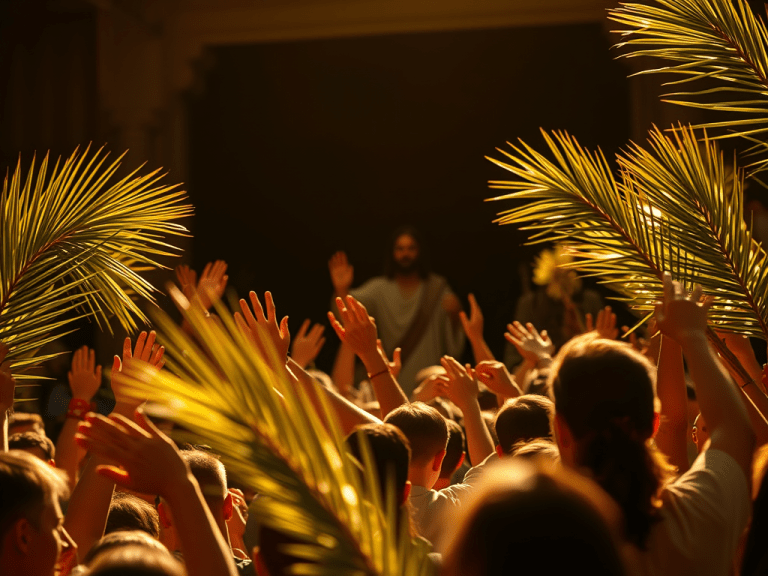
It’s a service with a few extra parts, all of which go back to the earliest centuries of the undivided Christian church. And, even when we go back and study those earliest Palm Sundays and Holy Weeks that we have recorded back in the 3rd and 4th century, it’s all dripping with drama – it’s full of emotion. And this day in particular is supposed to hit you like a giant mood swing, like the irrational tantrum thrown by a toddler: just a few minutes ago, you and I, part of the crowd, were joyfully singing “Hosanna!” which means “Save us!”. We’re joyfully welcoming Jesus as Lord, shouting ‘you’re the Christ! You’re the anointed Lord sent by God! Save us and help us, we need you!” It’s happy music, it’s the waving of palms and branches, it’s a victory parade down the aisle.
Hosanna! Blessed is he! Those were the words on your lips.
But then, moments later, what do you find yourself saying?
You see, that’s the harsh, dramatic reality of this day. It’s no accident that it’s you, and it’s me, it’s us, the same ones who proclaimed Him as Lord, now find ourselves shouting “crucify”.
This service, this holy week is dramatic. But it’s not just a play for us to watch.
The drama is on purpose… and it’s for a purpose.
And it’s all about remembrance.
But see, this is where we run into a problem, English-speakers in particular. Because we don’t have enough words to accurately translate that Christian idea of remembrance.
You and I, we hear “remembrance” and we think of history, something long ago and far away that shouldn’t be forgotten. We thing of happy things gone by, memories of something that used to be.
But that really isn’t an accurate translation of the idea of remembrance we find in scripture, the idea of re-membrance that Christ commands us to do “in re-membrance of me”, the idea where Paul instructs the church to re-member Christ’s sacrifice, proclaiming the Lord’s death until He comes again.
We’re not talking what we would normally call “remembrance”. We’re talking about re-membrance.
Re-member. To become a member once more.
Re-member. To join ourselves back together, like the limbs, the members of a body.
Re-member. To enter into the action, bringing it forth into our own day.
You see, the Christian observance of Holy Week should never be an exercise in learning history. When we hear – when we enter into – the scriptures and recount the events of Christ’s passion, we’re not just “remembering” or “recalling” something done long ago by some Jewish leaders or the Roman governor.
No, it’s that older Christian, and even older Jewish idea of re-membrance that goes back to the Passover, where God instructs and commands us to enter into the action, these life-changing, universe-changing, cosmic-level once-and-for-all events, that sure, on our time scale, happened “long ago and far away”, but were nonetheless done for us as they were done for all humanity, in every time and in every place, for every language, people, and nation, to be passed on and entered-into and made present once more every year, in every place, taught to each new generation, as we enter into and proclaim the live-giving, soul-saving, absolutely earth-shaking reality that Christ died as a sacrifice to save you. Yes, you, the same one who, moments ago, with all humanity, flipped from shouts of praise to shouts of “crucify”, the same one who, is just as much a sinner in need of grace as any person in that crowd or the soldier driving the nails.
As Isaiah prophesied, yes, all we – yes, we – like sheep have gone astray. We have turned – every one – to his own way.
Yes, this day is dramatic. But the reality of the brokenness of the entire universe is nothing short of the ultimate divine drama.
Why we need this drama.
We enter into these events as we are led deeper and deeper into the reality of our participation in the death of God’s own son – yes, it was me, and it was you – who participated in the events of this week, and why? Because it’s me and it’s you who, even all these years later, still need that once-and-for-all sacrifice to pay the wages of sin: death.
We, like all humanity, have sinned and have fallen short of the glory of God. We all die, and like the thief on the cross was able to admit, it’s harsh, but it’s right. It’s just the way it has to be for fallen humanity. We can’t offer a price for our own lives, because our lives are bound to death and sin and pride and greed… in fact, apart from Christ, left to our own devices, we’re totally enslaved to it, and the quicker we acknowledge that, the better.
We enter into these events to remind us, to lead us to re-member, to join ourselves once more to Christ, to God’s only Son, the one and only person who, because He was God in the flesh, wasn’t enslaved to sin, and could pay something far above and beyond what was owed, breaking the whole system of bondage, freeing all who trust in Him from the captivity of sin, as He tramples Satan under His feet and offers hope that bursts through the gate of the grave and the chains of death.
But it’s no good – no, in fact, it’s useless – if that’s a story, a faint memory, a tale of something that happened long ago and far away.
Our Place in the Story
Friends, in a few moments we will turn to the confession. It’s the same one we say week in and week out.
But, like everything else in the liturgy, it’s on purpose, and it’s for a purpose.
We confess our sins each week because it’s central to who we are and what we do. Each week, this week, last week, and yes, next week too, you and I will fall short of the glory of God. We will sin by thought, word, or deed, by things done or left undone, and we will continue to need a saviour.
But remember: complete, utter, and ongoing reliance on God is not a bug, it’s not a failure. No, it’s a feature of how humanity was intended to be: completely, utterly, and forever reliant on God.
Like the thief on the cross next to Jesus, it’s time to admit that you need Jesus. That you need to enter into this Holy Week, because, yes, in fact, you are a part of that crowd, just as I am.
You and I, we need, and it is our privilege, to re-member, to join ourselves up with those disciples who gathered on Thursday night to receive a new commandment, to have our feet washed by our servant King. We need, and it is a part of our confession, to walk with Christ to the garden of gethsemane overnight on Thursday, where he told us to watch and pray, but we, like the disciples, find our eyelids heavy and our hearts distracted. We need, and it is for us, that we follow Christ to the cross on Good Friday, that amazing, horrible, terrible, and wonderful cross, the one that you and I caused, and from which you and I eternally benefit, and it’s really only then, that we can truly share in and proclaim that unspeakable joy of Easter.
So my friends, embrace the drama – and block out your calendar – because this Holy Week is God’s gift to you. It’s God’s invitation for you to enter into those events of long ago and far away, and to join yourself to them, so that you, as a follower of Jesus, can know Christ and make Him known, in every age, in every place… and for His glory, now and forevermore. Amen.


 Bishop Alexander Pryor