Shrewd Managers

Luke 16:1-13

Today the Church gives us what is certainly one of the most difficult sayings of Jesus; indeed, at various points in Christian history, the Church has been outright embarrassed by these ancient words passed down for us to hear today.

We’ve grown accustomed and even expect Jesus to raise the bar on obedience – “the law said don’t commit adultery?  I say don’t even look at another person with lust;” “the law says don’t murder?  If you hate your brother or sister, you’ve already committed murder in your heart.”

We’ve grown accustomed to hearing Jesus calling people to keep the law rightly, as he summarized in the two great commandments: love God with all your heart, soul, mind, and strength, and love your neighbour as yourself.

And yet, now, we hear Our Lord commend this dishonest manager, one who, by any objective standard, falsified the accounting books to ensure that he would land on his feet after he was fired.

It’s no surprise the Church found this passage embarrassing over the ages – on face value, there’s no question – this manager is not a good guy.  You don’t want this guy working for you.  What a mess we would be in if we read this passage and concluded it with a hearty “go and do likewise”.

It’s a hard text, but it’s one that deserves our attention precisely because it doesn’t say what we expect; and when we think we’ve got God all figured out and conveniently ignore those hard parts of his Word, that’s when – time and time again – we find ourselves dangerously close to worshipping a god made in our image, rather than the one in whose image we were made.

A Parable in Context

If we were to open our Bibles to Luke 16, the first thing we would find is that this passage doesn’t exist in a vacuum.  It’s a parable – a certain type of story, often using unexpected characters and situations to teach a lesson, and if we were to flip back a page in the Gospel of Luke, we’d see that it exists as part of an extended collection of more familiar parables: last week we heard the first part of Luke 15 – the parable of the lost sheep and the parable of the lost coin, a pair of stories told to illustrate God’s persistence in finding even one who is lost.

Then, later in Luke 15, but not in the lectionary this year, we have the well-known parable of the prodigal son.  We all know it well: a wealthy man has two sons and divides his wealth among them.  The younger one takes his money and travels the world, spending this great fortune on fabulous parties and wild living, and eventually finds himself broke, on the streets of a foreign land, feeding pigs and perhaps sleeping in their barn just to have a roof over his head. 

Now, with all of his father’s hard-earned wealth wasted, he returns home begging for his father to take him back as a hired hand. 

And what does his father do – he welcomes him with open arms, forgives the wasting of the family wealth, and, like we saw with the lost sheep or the lost coin, celebrates that this one that was lost has been found.  Of course, as we might remember, the rich man’s other son is angry, saying, “look, my brother wasted all your hard-earned money, but I’ve worked hard at the family business all my life – why are you celebrating?”, the moral of that parable of course being that it isn’t about the wasting or the dishonour or disrespect brought upon the family, but it’s about the restored relationship between a loving, merciful father and a child that had wandered away.

And it’s as part of that string of familiar stories that Jesus tells the parable of the dishonest manager.  

Jesus’ Theology of Money

If we want to understand the point that Jesus is making here, we have to first take to heart his absolutely radical, earth-shattering approach to money.

We all know “Money makes the world go round”.  Every one of us in the room base many of our day-to-day decisions on their financial impact.  In today’s world, it’s money and livelihood that brings communities together, as we grow up and, more often than ever before, have to leave home in search of work and… money.  Money to buy what we need – food, shelter, clothes; money to buy what we want – cars, books, toys of whatever sort, whether it be a Nintendo or Xbox or a boat and skidoo; and money to plan for our future – to pay off debt, to put something away for our kids, to have a place to call our own.

Money, for better or worse, is the driving force behind many of our choices: decisions to work harder now to pay off that student loan, or to put off retirement for another year to pay off the truck and take that great vacation.

And if we actually read Luke 16, perhaps the most unexpected thing that we find is that Jesus is actually acknowledging the role of money in our lives.  Jesus, having just told the parable of the prodigal son who wasted his father’s wealth, and who as told the rich man to sell his goods because it is easier to enter the eye of a needle than for the rich to enter the kingdom of God, takes this opportunity to teach his disciples – you and me – about worldly wealth.

“I tell you, use worldly wealth to gain friends for yourselves, so that when it is gone, you will be welcomed into eternal dwellings.

“Whoever can be trusted with very little can also be trusted with much, and whoever is dishonest with very little will also be dishonest with much. So if you have not been trustworthy in handling worldly wealth, who will trust you with true riches?

The problem is not money.  The problem is when we forget what money is.

Money is not God.  Money is not the master.  You cannot serve two masters.

So if money is not the master, then what is it?

Money is a tool. 

It’s a worldly tool; all tools are.  It’s not as though God installed ATMs and printed bills with his face on them to use in the garden of Eden, where, without pride and greed, everyone’s needs were met without toil or labour. 

Money is a tool.  And tools, even worldly tools, can be used for good or evil. 
A hammer can be used to build or to destroy; fire, used wisely, gives light and heat, but left to its own devices will consume everything around it.

Money is decidedly worldly – it does us no good in the Kingdom of God; we can’t buy our way in, and we can’t take it with us.

But, in this world, we find ourselves entrusted with it. 

“And the master commended the dishonest manager because he had acted shrewdly.  For the people of this world are more shrewd in dealing with their own kind than are the people of the light.”

Now, let me be clear – this is not about stealing.  This is about Christians understanding the right use of money – not as a supreme goal or measure of worth, but as a tool, as a means for accomplishing things in this world.

The Dishonest Manager

As was common in the first century, the master had hired a manager to oversee this area of his business.  And business managers, like tax collectors were entrepreneurs rather than servants working for room and board; they had a quota due to their master, and then they would add their commission over top, or charge interest if one of the debtors had missed a payment and the manager had to cover the expense.

When the manager’s position came under scrutiny and it looked like his contract wouldn’t be renewed, a short-sighted manager, one viewing money as the goal rather than as a tool to be used, would have called up the debtors and demanded payment.  A short-sighted manager would have said “I’m going to lose my job, I need to collect some money right away”.

But this shrewd manager said, “they’re going to cut my position, I need to make friends while I can so that, when I’m no longer in authority, I have people to look out for me.” So he calls them in, slashes his commission, writes off the interest, and sends them on their way.

He writes-off the debt that is rightfully his because he knows that his time is short. 

He writes-off the debt that is rightfully his because he knows that money can only get you so far; that worldly wealth runs out.

He writes-off the debt because he understands that everything he has ultimately belongs to the master, and can be taken away at his next breath.

A Parable Applied

Now, remember the prodigal son? 
Remember the undeserved mercy shown by the Father?

God is the master.  We are the managers.  The Master has given us everything – grace, forgiveness, blessings beyond measure, and he has put us in charge of his accounts.

But word comes to the master that we’re squandering his possessions.  That grace, that mercy, that forgiveness, those blessings, those positions, that influence – we’re not using them to their full potential for the master’s kingdom.

So, he wants an account.  He wants to check the books.

And this is where he wants us to be shrewd.

So, we call in those who owe us.  Our debtors; or to use the older language, those who trespass against us.  And recognizing that everything that we are owed pales in comparison to what we have received from God, and realizing that whatever worldly wrongs done to us, whatever we are owed, is worth nothing in the age to come, we forgive, we write-off those debts.

For whoever is faithful in little will be faithful in much.

And, in forgiving our debts, in laying down what is rightfully ours, in not seeking revenge, in repaying wrongs with kindness instead of anger, we use our worldly powers to gain friends for ourselves, relationships which reflect the mercy that we ourselves have received from God, and which will pay eternal dividends.

No one can serve two masters.  But, use your worldly wealth – money, positions, power, influence, relationships – the things that, in the long run matter very little and will pass away; use them in such a way that we will be welcomed into our eternal dwelling, where we will be entrusted with true riches – abundant life where neither moth nor rust destroy and where thieves do not break in a steal – for where your treasure is, there your heart will be also.

To God be the glory, now and forever more.  Amen.

The Cross: Cosmic Solution to a Universal Problem

Today is all about the Cross.

This weekend, many Christians around the world are celebrating Holy Cross Day – a Holy Day that, according to our own church calendar, ranks just below Christmas, Epiphany, Easter, and Pentecost.

This celebration of the Holy Cross is an opportunity for us to look at the cross once again, something we normally do in Lent and particularly on Good Friday, but to see it now with a different emphasis, to look at it in a different light.

Historic and Individual – Cosmic and Corporate

On Good Friday – and the majority of other times we think to the Cross – the focus is on the earthly work which Christ accomplished for us.  What do I mean by that?  Well, the focus is often on the Cross as an instrument of death, the Cross as the place where an angry crowd, a crowd in which we all find a place, was spurred on by jealous politics and empty pride to put an innocent man to death, a death, as we hear each time we celebrate the Eucharist, he freely accepted, offering himself to reconcile humankind with God.  The focus, almost exclusively among some of our Christian brothers and sisters, is on the blood that was spilled, in keeping with the Old Testament imagery of sacrifice, where since that first time that animals were killed to make clothing to cover human nakedness, it was blood that paid the price for the shame of our sin.

On Good Friday, the focus is so often on the individual.  Even in our music – “When I survey the wondrous cross”, or “were you there when they crucified my lord?”. 

That focus on the individual isn’t a bad thing – in fact – to quote another old song, everyone one of us, at some point, need to decide for ourselves if we will follow Jesus (“no turning back, no turning back”).

But as good as it is to focus on the Cross as a place of sacrifice for us as individuals, and to focus on the Cross as a historical event which we recall when we gather, that’s only part of the story. 

Today, the Church gives us an opportunity to view the cross not as an instrument of death, but as the symbol of victory; victory, once and for all, over the grip of death; victory, once and for all, over the power of shame and guilt for past wrongs to which we are shackled, and which so often hold us down until we’re crushed under their weight.

Today, the Church invites us to look at Christ’s death on the cross not only as a historical event impacting your individual life, but to view the power of the cross on a universal, cosmic scale: that singular moment of sacrifice and victory as a ‘big bang’, if you will, that ripples out through the whole created universe, changing the very fabric of life itself, as everything that happens when time and eternity meet, in that moment after we take our final breath, is forever changed.

Today, the Church invites us to think upon the power of the cross as it really is; though, like a star being born in a distant galaxy, the light, the experience of that truth is not yet visible to us as we journey through this mortal life.

Death defeated by death.

In the Cross, Death is defeated by death.

In the Cross, Death – the power of the grave over creation – is itself defeated as it tries to close its jaws on the one who cannot die.

And, in that moment, the lifeless body of the incarnate Son of God lying in the tomb becomes not a sign of weakness or mortality, but, as the scriptures say, he becomes the firstborn from the dead – a new “Adam”, piercing the veil between life and death and opening the door into the new creation – and, again as the scriptures tell us – not the fluffy, disembodied “heaven” of fairy tales or romantically inaccurate Sunday School lessons, but to lead us into the city of God, where we, in our resurrected bodies, share in the life of the resurrected Christ.

Of course, “death being defeated by a man who dies” hardly looks like victory to those looking on.  Indeed, in our epistle today, Paul admits this as he calls out, “Where is the wise man?  Where is the teacher of the law?  Where are the philosophers of this age?”[1]  Come, explain this, teachers and lawyers!  From a human perspective, from those only thinking about creation from our little place in the vast universe, “the cross is foolishness”.  But, Paul quotes from Isaiah 29: this is no surprise, for God says that in the day when his power is put on display, the world will be turned upside down, the wisdom of the wise will be destroyed, and all the understanding and theories of the intelligent will be frustrated as a new structure is put into place.

We see this new structure, death defeated by death, foreshadowed in Moses.  Like so much of what Jesus does on an eternal and universal scale, we see it first in earthly, human terms as God delivers his people Israel. 

They are led through the Red Sea from bondage into freedom, as we are led through the waters of baptism.  They are fed in the desert with food from heaven and water from springs, as we are fed with the bread of life and drink from the cup that runs over.  And they are led through by God through a time of wandering in which they learn what it means to trust in God and to repent and return when they go astray, as the Holy Spirit leads the Church in our own day.

In the lesson we heard today from Numbers chapter 21,[2] we find God’s chosen people growing impatient and wavering once again in their obedience and trust; as a result, they come across poisonous snakes who begin biting the people in their tents.  Realizing that it was God who was protecting and providing for them, they repent and beg for the snakes to be taken away – and God says to Moses, make a bronze snake and put it on a pole, and lift it up for the people to see; anyone who is bitten can look upon that pole – a sign of God’s power over creation – and they will live.

The very thing that was harming them – snakes – was defeated as God claimed his authority over it; and in looking upon it, they were healed.

We, like all people, are chased and bitten by death.

And, Jesus says,[3] “Just as Moses lifted up the snake in the wilderness, so the Son of Man will be lifted up, that everyone who believes in Him may have eternal life”.

Death itself, an innocent man, beaten, bruised, stripped, shamed, tortured, abandoned, and hung to die – is defeated as God claims his authority over it; and that gruesome image becomes the gift of life to all who believe.

The power of the Cross is the triumphant power of life over death itself.

Searching for the Lost

But it’s not enough that God would defeat death and then leave us to figure it out.

The glory of the Cross – indeed, our whole faith — is that God himself sees the worth, sees the intrinsic value in each human man, woman, and child made in his image, and seeks to bring them home.

It’s that wonderful parable of the lost coin.[4]

This woman has lost no ordinary coin.  Rather, in 1st century Palestine, one sign of a married woman was a set of coins sewn to her headscarf; some suggest this was part of the dowry, and in times of need – like if the woman were to become a widow – it formed a small savings that could be used.

It’d be like one of us today who lost a wedding ring. 

The ring might not even be of great monetary value – it might just be a plain gold band – but in the eyes of the ones who gave and received it as a sign of their vow, it is of incredible worth.

You look, you look again, you clean the house, you retrace your steps, you do all in your power to recover that thing that means so much because of the pledge, and the love attached to it.

And the Cross is the story of that person searching for that which is of great value, as each and every person – regardless of what they did with their life – bears the image of God, and was wired to live in relationship with him.

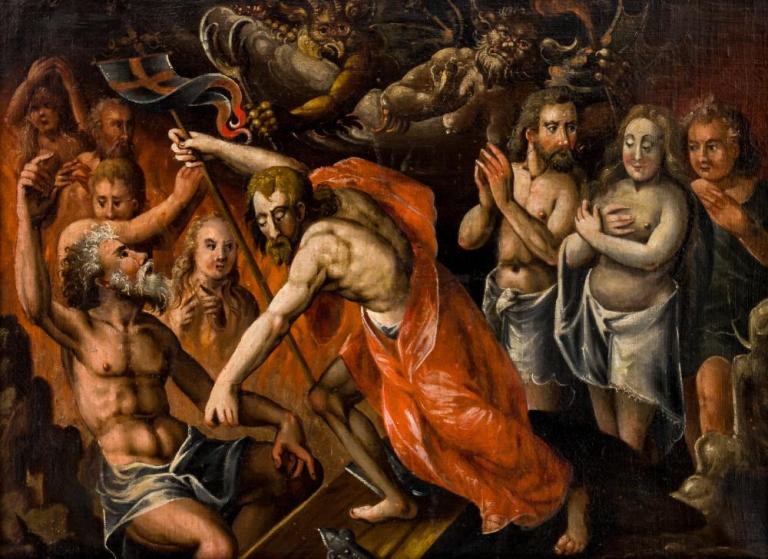
This is that part of the Creed that we recite each week: Jesus suffered under Pontius Pilate, he was crucified, died, and was buried.  He descended to the dead.

Or, in the older prayerbook language it’s even stronger: he descended into hell.

Think about that: God loves you and me and every person that he has made so much, that Christ not only died, but descended to the place of the dead in order to find and release those who were in bondage. 

This is where the New Testament[5] would speak of Christ preaching to the dead as his body rested in the grave on Holy Saturday, like the shepherd or the woman who doesn’t rest until every effort has been made to find that which has been lost.

And, in the parable, there’s great rejoicing when that which was lost has been found; and in the Power of the Cross, Jesus himself becomes that strong man of Mark chapter 3,[6] who ties up Satan and the powers of Death, so that he can plunder his house, and that house – the place of the dead – now divided against itself will fall as Christ arises victorious, leading captivity captive as he invites us to share in his risen life.[7]

Our Hope

This is the power of the Cross.

Not a fairy tale or a distant historic event, but a cosmic event whose ripples are moving throughout creation until that day that the light of that Truth finally reaches our eyes.

So, we live in hope – eyes firmly fixed on the Cross – that tool of death that becomes for us the way of life, as the one over whom death has no power destroyed death once and for all.

…Just as Moses lifted up the serpent in the wilderness – look up, and live.  Amen.


[1] Paraphrase of 1 Cor 1:18-24

[2] Numbers 21:4-9

[3] John 3:14-15

[4] Luke 15:1-10

[5] 1 Peter 3:17-22

[6] Mark 3:26-27

[7] Ephesians 4:8-10

The Potter and the Clay

So I went down to the potter’s house, and there he was working at his wheel.
The vessel he was making of clay was spoiled in the potter’s hand, and he reworked it into another vessel, as seemed good to him.
(Jerimiah 18:3-4)

“You are the potter; I am the clay”.

This is, no doubt, one of the more familiar images we have to describe our relationship to God, his patience with us, and his fearful-but-wonderful ability to re-shape us and re-fashion us for his service.

It’s a beautiful image that has been used again and again in hymns and songs, especially in the last 50 years, as we sang just a few minutes ago.

Yet, if we’re going to allow ourselves to learn from the wisdom handed down to us in the scriptures as interpreted by the Church, we have to be careful; we have to be careful not to let romanticism or cozy sentimentality cloud our understanding of these powerful words.

In our lesson from Jeremiah chapter 18 we have a powerful image, but if we’re to understand it, we have to be careful not to let our modern circumstances get in the way.

Jeremiah is called by God to visit a potter’s workshop, where God, by his Spirit, gives him a word of caution to speak to a people who have forgotten their covenant with God – a people who have done the rites and rituals required of them, but whose actions and attitudes don’t match their words; it would be like someone who is baptized, who has promised to turn away from evil, to proclaim the good news of forgiveness in Jesus by word and example, and to love your neighbour as yourself, but whose life doesn’t match those lofty words.

It’s in this context that we find the image of the potter and the clay.

And it’s important, too, that we take a second and allow the image to sink in.

Maybe you, like me, have had a chance to visit a pottery studio.  In our day, potters are artists, specializing in vases and ornamental work; the studio I visited was pristine – beautiful art on the walls, a nice area where you could stand and watch the potter working at the wheel, while the finished pieces baked behind the glass of a kiln at the back.

But, we have to be careful not to let our own experience cloud the message.

The potter in Jeremiah’s day is not an artist, but a tradesperson working to keep a city functioning, and the product is not something beautiful to admire on a shelf, but the everyday stuff that makes life possible – clay jars to store flour and oil to preserve the harvest so that the people survive the winter; pots for cooking soups and stews to stretch you meat and vegetables to feed a family; even chamber pots and, in Jeremiah’s day, ceramic pipes to direct waste into the sewer.

This is no beautiful, romantic image of an artist in a pristine art gallery.

The potter works tirelessly under the heat of the Mediterranean sun; it’s sweaty work, mixing the mud and turning the wheel by hand; the potter is covered head to toe in sticky clay, as the workshop attached to his house is filled with the bitter smoke of the fire in the kiln, as he lives and works in the industrial part of town, alongside the slaughterhouse, the butcher, and the tanner. 

God with us.

And this, my friends, is the image of God that Jeremiah gives us.

Yes, God is Almighty; yes, he alone is above all kings and powers, and worthy of all worship; but, in spite of that, our God gets his hands dirty. Our God is not limited to the palace, though he’s a great king, but is found in the dirty workshop on the outskirts of town, intimately involved in fashioning the everyday, commonplace vessels needed for everyday life in the city of God.

This is no artist working in a rarefied, gleaming gallery; this is a skilled craftsman who makes what is needed for the city to thrive.

You are the potter, I am the clay.

It’s important, too, that we remember what that means.

While much of Christianity in the last century has focused, perhaps overly so, on us as individuals, the clay is again a powerful image to remind us of our relationship with God.

You see, at no point does the potter need the clay’s permission to remould it.

Think about that for a second.

While it runs counter to the individualism and freedom that we so often enjoy, what potter looks at the clay and says, “is it alright if I mould you today?”. 

Imagine your neighbour buys some lumber to build a fence, and you look out, and there they are, picking up each piece, holding it close to their face, and asking, “is it alright if I cut a few inches off to make you fit?”, or “would you to stand upright, or would you rather be a horizontal beam?”.

That’s ridiculous! 

But that’s also the point that is being made in Jeremiah.

Verse 6: “Can I not do with you” – my covenant people – “just as this potter has done?  Just like clay in the potter’s hand, so are you in my hand”.

No, the potter, a skilled and careful master at their trade, takes the lump of clay and sets out to turn it, to mould it, to shape it into something useful; the potter’s desire is to take that raw clay and give it a purpose.

The potter takes what the world looks at as dirt, but the potter knows its value. and skillfully, lovingly, brings that value to the surface as it is shaped to do the work that the potter intends.

And, in these terms, in this context, the image of the clay and the potter takes on a different light. 

Uncooperative Clay

In Jeremiah, we’re told that the clay is not cooperating with what the potter has in mind.  The potter set to work, but they clay was spoiled – as the clay is moulded, it dries out, it cracks, it won’t hold its shape.

But the potter isn’t wasteful; the potter doesn’t throw tantrums because of the wasted effort.

The potter, calmly, as a skilled master, simply pushes the spoiled clay back into a ball, washes it, pours on water to make it malleable again, and reworks it, again and again, until the clay takes the shape that the potter intends.

You are the potter, I am the clay.

If that’s true, then God is – even now – shaping you and me into a vessel that serves a purpose in his Kingdom.

He doesn’t need our permission, and our loving, patient God is working on every one of us, every person made in his image, whom he loves, and for whom he is willing to leave his throne and get his hands dirty.

Our call, though, as the Lord said to Jeremiah, is to cooperate as he shapes us by his hand.

Israel was given the covenant which was intended bless them, but, in the days of Jeremiah, they had forgotten that their obedience wasn’t just about rites and rituals, but about their actions and attitudes; the clay was drying out and wouldn’t keep its shape.

Our New Testament lessons today call us to cooperate, making the hard decisions asked of us under the New Covenant. 

To make the decision to put pride aside, and to welcome back those who have wronged us as a brother or sister.  The decision to prioritize and to trust in God, and to realize that, so often, we take the blessings that God has given us – family, talents, possessions – and turn those blessings into idols, or allow them to become badges of pride, as though one lump of clay sitting on the potter’s wheel could look down at another, when both are a work in progress.

The Cost of Discipleship

Our call is to cooperate – “to count the cost”, realizing that whenever we let go of those blessings that we have idolized – whether it’s the wealth and power to build a tower, or whether it’s the wholesome, God-given blessings of family – whenever we let go of our grip on what God has given us, we’ll find that we’re able to really receive the peace of Christ, to receive forgiveness for the past failings that we’ve been clinging to, and to find that – to our amazement – the potter is never done with us; when we’re broken down, when we’re worn out, he doesn’t throw us away, but reshapes us and gives us a purpose in his Kingdom. 

Our call is to count the cost and be a disciple.  When we’re worn out, when we’re exhausted, when we’re dried up, trying to resist the potter’s hands, we hear the call of Jesus to give up everything – mother, father, family, and even life itself.  And that sounds crazy.  But, you see, when we’re resisting the hands of the potter, it feels like to give in, to let God reshape us, will cost us everything. 

But, in the hands of the potter, cooperation with the will of God doesn’t cost us anything except our pride.

Let us pray:

Have thine own way, Lord.
You are the potter, and I am the clay.
Mould me, and make me after your will;
Fill me with your Spirit,
Till all shall see Christ:
only, always living in me.  Amen.

Harsh Words (and True Faith)

Isaiah 5:1-7, Hebrews 1:29-12:2, Luke 12:49-56.

By faith, the people passed through the Red Sea.
By faith, the walls of Jericho fell.
By faith the people of God conquered kingdoms, administered justice, obtained promises, shut the mouths of lions, quenched raging fire, escaped the edge of the sword, won strength out of weakness, became mighty in war, and put enemies to flight.

The lessons that the Church gives us for this Sunday and the weeks that follow show us the real meaning of “faith”, and what it really means to be a member – by faith – of the Church.

On the one hand, if we paid attention to the lessons today, we might admit that they’re rather harsh; they’re certainly not in keeping with the sorts of actions that we most often associate with Christianity. 

In Isaiah[1], we heard that God had chosen and planted his vineyard, and as a loving gardener, tended and fertilized the ground, blessing the vines with everything they needed to produce good fruit.  Of course, vines and vineyards and producing good fruit are all very familiar images – Jesus says, “I am the vine and you are the branches,” and the scriptures are full of encouragements to cultivate and bear the good fruit of the Spirit – yet, in todays lesson, we see the flipside of that: God, who always keeps his word, delivers the consequences for those chosen and blessed vines who, in spite of all God has done for them, didn’t produce the fruit that the gardener expected.  And it sounds shockingly harsh: “I will remove its hedge, and it shall be devoured; I will break down its wall and it shall be trampled down.”

Yes, I am the vine and you are the branches, but these are certainly strong, maybe even unexpected words for those that fail to produce fruit.

Then, perhaps even more shocking, is our Gospel from Luke.[2]

Here, from the lips of our loving, merciful Saviour – from the same lips that welcome children, the poor, and the oppressed, and pronounce the forgiveness of our sins – we hear “I have come to bring fire on the earth”.  And, perhaps more shocking still: Jesus said, “do you think I came to bring peace on the earth?  No, I tell you, but division”.

On their own, these lessons sound as if they contradict so much of what we’ve been taught.

After all, we believe in a God who heals, a God who offers second chances, a God who like a loving father welcomes the prodigal son or daughter home with open arms.

These lessons, on their own, appear to say the opposite.  What are we to make of that?

How we ought to read the Bible

First, we have to make sure that we are reading scripture as we as Anglicans believe it was meant to be read.  Actually, our Anglican faith and practice forbids us from picking and choosing verses of the Bible just to make a point.

On the one hand, our branch of the Church throughout the world proclaims that the scriptures – the entire scriptures – contain all things necessary for salvation.[3]  That’s actually a central point for Anglicans around the world, even though we sometimes forget it.  We believe that, while the scriptures were written down by a variety of people over many centuries, it’s intended to be read as one book, one story of God’s love for us unfolding over history,[4] written and handed down for our benefit, and entrusted to us for those who come after.

On the other hand, though we sometimes forget, and sadly there are even clergy today who haven’t read them, Anglican Christians throughout the world are guided by the Articles of Religion, the set of beliefs and declarations that sought to settle the controversies of the reformation.  And there, we’re taught very clearly that the Church does not have the authority to read any one piece of scripture as though it contradicts another.[5]  Thankfully, if we’re going to be true to our Anglican heritage, we don’t have the freedom to engage in the sad battles where people who call themselves Christians pick and choose their favourite, most convenient verses to hurl at each other in the sorts of loud, messy battles that do nothing than strike each other down and hurt the work that we have been given to do in a world that so desperately needs to hear good news.

But that brings us back to the question:

As people who are about to once again confess our sins and hear the assurance of God’s forgiveness, what are we to make of the warning of God of the consequences for those in the family of God who don’t bear good fruit?

And, as those who in a few moments will greet one another with the peace of Christ, what do we make of our Lord himself saying “I didn’t come to bring peace, but division”?

True Faith

The key to holding these statements together is nothing less than that bold faith that we hear in Hebrews.

A bold faith.  An active faith.

Too often, the church allows itself to become the sad, sometimes pathetic caricature that we see portrayed on TV.  You’ve seen it: either people of faith are portrayed as – and sometimes allow themselves to become – bitter, angry warriors who hurl cut-and-pasted bible verses at one another; or, especially on TV comedies, Christians are portrayed as – perhaps because we’ve allowed ourselves to become – passive, feeble followers, easily tricked or taken advantage of, and unable to answer the questions of the age.

And to be clear, neither one is the faith we see described in the scriptures.

You see, one of the reasons we sometimes find scripture confusing or contradictory, and one of the reasons the Church throughout history sometimes finds itself confused and idle, is that we all too easily lose the distinction between the eternal, never-ending rest and glory promised by our Lord, and the true work and sacrifice to which we are called here and now.

It’s this question that guides us in reading scripture, and guards us against interpreting one passage of scripture as contrary to another: we have to ask, “is this about who I am, as one made clean in the waters of baptism and forgiven by Jesus”, or, “is this about what I should do, as a member of the Church and a disciple of Christ”. 

The “Who I am” piece is certain for those who trust in the Lord.  No matter how many times I mess up, if I trust in God, he’ll take me back.  That’s the new life that we’ve been offered.

The “What I should do” piece refers to each moment, as we make decisions about what we should say or do.  That’s those hard words we hear so often in scripture, that, though we are a new creation, we must daily die to self; that, though we are made sons and daughters of the king, we approach God as humble servants; that though God is in control, he asks and expects us to be his hands and feet in the world.

Living Boldly: The Life of Faith

We, as members of the Church, are called to have and live a bold faith.

We’re called to have a faith that is active, a faith that accomplishes things

This is not “faith” as the world defines it.

We’ve allowed the world to define faith as “wishful thinking”, or as one former professor put it, we’ve bought in to the parody and have allowed the purpose of church membership to become simply “pie in the sky, by-and-by, when you die”. 

Those who oppose the place of religion in modern society often define faith as “the suspension of critical thinking”, or that faith is “a belief held without evidence”.

And, sadly, many in the Church have adopted that definition.

In Hebrews, we’re told how we should define faith:

“Now faith is the assurance of things hoped for, the conviction of things not seen”.

Now, I admit, it’s easy to see how the world gets this wrong.  Simply, they get it backwards, and sometimes, we do too.

Faith is the assurance of things hoped for.

That does not mean that having faith means hoping for something.

In fact, if we think about it, it means the exact opposite.  Faith is the assurance of things that we hoped for.  Faith – “I believe” – is that deepest affirmation that comes when our hopes have been assured, when they have been brought to light.

Faith is not saying “I hope God will heal me”.  That’s backwards. That’s not faith; that’s hope.

Faith is saying “based on God’s goodness, and what he has done for me and for the world, and his gifts to me, I’m convinced, and I believe that he will work all things together for good in my life”.  It’s a huge difference.

Faith is not saying, “I don’t understand but I believe anyway”.  That’s well-intentioned, and yes, a child-like faith is sufficient, but it’s still backwards.  Afterall, one of the marks of childhood is endless curiosity!  Faith is a gift from God, and it cannot be mindless – it’s the conviction, the assurance, of things that we cannot see.

It’s not that we blindly trust in what we cannot see, as though we throw our hands up in despair; it’s that we are convinced and sure of things we cannot see because of our faith – because of the things that we have seen, the things that we know and believe are true.

Above all, faith isn’t a “giving up” of understanding or the God-given gift of reason; instead, the Church teaches quite the opposite: faith seeks understanding, as God desires to reveal more of himself to those who follow him.

This faith isn’t feeble or passive.  It doesn’t produce churches and congregations that sit idly by, or who are confused about speaking the truth in love as they invite the whole world to come in.

It’s a faith that, as we heard, parts the Red Sea.  A faith that shakes the walls that divide.  It’s a faith that conquers kingdoms, and brings justice, and stops the edge of the sword, and wins strength out of weakness.

This faith does things. 

Back to those harsh words…

And, when it doesn’t – because we, the Church, have got it backwards, or because we’re unwilling because of fear of persecution to live that faith – that’s when we fail to produce fruit, even though we’re branches on the vine that God himself planted.  And, as the fruit is for the glory of God and for the sake of the world, as we heard in Isaiah, that’s when God takes down the wall and lets the vines be trampled, because they’re no longer serving their purpose.

And, the division that Christ says he will bring?  That’s not his goal – that would be to make one part of the Bible speak against another.  Rather, it’s the result of the changes that he ushers in by faith.

When we, with our absolute deepest convictions, set out to do the work he has given us to do, freeing those who are oppressed, caring for the homeless and the stranger, loving others as ourselves, it’s that healing and that freedom in Christ that causes division: division with those who love evil, who thrive on oppressing those in need, and who put their trust in their wealth or their own strength.

We believe, we have faith in, the peace of Christ – that’s who we are.  But our bold faith calls us to action, action that – that’s what we are to do.   Action that, Christ warns us, will cause division, as we are his hands and feet to serve and free the suffering in this broken world.

By faith, the people passed through the Red Sea.
By faith, the walls of Jericho fell.
By faith the people of God conquered kingdoms, won strength out of weakness, and put enemies to flight.

May God give us this bold faith, that the Church may arise, ready to serve our master.  Amen.


[1] Isaiah 5:1-7

[2] Luke 12:49-56

[3] Enshrined in the Solemn Declaration of 1893.

[4] Articles of Religion #7

[5] Articles of Religion #20

The Clothes Make the Man (or Woman)

Colossians 3:1-11

When I was a boy in Sunday School, there was a song that we would often sing.  It goes like this:

            Oh, be careful little eyes what you see;
            Oh, be careful little eyes what you see;
            For the Father up above is looking down in love,
            So be careful little eyes what you see.

Maybe you’ve heard it.  The other verses go on to warn little ears to be careful what they hear, little hands to be careful what they do, little feet to be careful where they go, little minds to be careful what they think, and little hearts to be careful who they trust.

It’s a simple song, but in spite of it’s childlike simplicity, it shares much in common with what we read in the scriptures today. 

In Colossians, we are told that we are a new creation, remade as those baptized into the death and resurrection of Christ, and, St. Paul goes on to teach us, as those who now share in the life of Christ, we are to put off the thoughts and actions that define our world full of pain, grief, and shame. It’s a list of vices that isn’t news to any of us: sexual immorality, lust, evil desires, greed, anger, rage, slander, filthy language, lying to get ahead, and creating divisions amongst ourselves.

To borrow the extended image used by St. Paul, these are things that worldly people carry around with them, wearing these thoughts and actions as a garment, as clothes as they walk about.  And, to some extent, whether we like it or not, the old saying holds true: the clothes make the man.  Our identity is shaped by the image that we project to our friends and neighbours, and that image then shapes our attitudes, our thoughts, and our actions.  It’s like the kid who knows she has the coolest clothes, and allows that to become who she is, and shape how she treats other people.

Today’s lesson tells us to strip off that worldly clothes; to strip off that impurity, greed, anger, those lies and divisions, and instead to clothe ourselves with thoughts and actions that imitate Christ.

The implication, of course, being that we aren’t stuck in those sins as though they define us.  As comfortable as we get in well-worn clothes, and as much as wearing that favourite old shirt becomes a habit, if we choose, we can change them, and put on the garments of righteousness given to us at baptism.

Now this list, sexual immorality, greed, anger, filthy language, there are no surprises there, this is nothing new.  These are all things that, at some point, our parents, other family members, our clergy, and our teachers taught us, even if, in some cases, they didn’t practice what they preached.

A stumbling block

Yet, it’s this same list that becomes a stumbling block for so many who have left the church.  We’ve all heard it, I’d say especially from men who have wandered away from the church: “The church is full of hypocrites.  He’s selfish, she’s a gossip.  That one’s as greedy as you can imagine, and if that other one has a drink, you’d never believe the words that come out of their mouth.  Christians?  If that’s a Christian, I want nothing to do with it.”

All of us, as children, were taught to keep away from these worldly desires; all of us, one way or another, were warned to be careful of what we see, do, or say with our little eyes, hands, and mouths, often with the stern message that “God is watching”.

Many of us, for better or worse, were taught that purity – right actions, proper gratitude, good manners – would buy us favour with God.  Many of us were taught that it’s as though God was keeping a tally, like an eternal, heavenly “swear jar”, where we have to throw in a quarter for every curse word that crosses our lips, or do a good deed to make up for our failings.

And, if that’s the case, then those outside the church are right – the church is full of hypocrites.

Because the truth is, once we strip away the glossy exterior, every man, woman, and child alive continues to struggle with impurity and greed, with anger and rage, with filthy language, dishonesty, gossip, and divisions.

The reason for purity.

Oh, be careful little eyes what you see.

The problem, though, with that Sunday School song is that it has the message backwards.

So many, both inside and outside the church, think that the Gospel message is that we are to do good, live the best life you can live, and earn heaven as the reward.  So many think that living a “Christian life”, living a pure and righteous life buys us eternal life.

But that’s to have the message bottom up.

Yes, and it’s so important that the scriptures tell us in multiple places, we’re to avoid immorality and adultery, impurity, and greed.  Yes, we’re to avoid divisions and lewd speech and drunkenness.  Yes, we’re to refrain from anger and dishonesty.

But we don’t do that to earn our place in the church or in the family of God.  And, our place in the family of God doesn’t depend on some heavenly tally, whereby any one of us could pat ourselves on the back and say, “wow, aren’t I a good Christian”.

No.  We do our best to live in imitation of Christ because all of us – no matter what we’ve done, or whether our struggles are invisible or open for all to see – all of us have been invited to take off our worn-out earthly clothes and instead clothe ourselves with the grace of Christ.

I don’t try to live a pure life to earn heaven.  It’s the opposite.  Because Jesus loves me, I will live my life in a way that honours him. 

And if our neighbour’s struggles are more public than our own, we reach out to them in love, knowing that it’s only by the grace of God that we haven’t found ourselves in their situation in this broken and messy world.

Indeed, the Church – our church – is not called to be a museum for saints.  The church is a hospital for sinners, a home for the beloved children of God who have accepted the invitation into God’s family.

Yes, be careful little eyes what you see; and be careful little ears what you hear. 

But remember, it’s our Lord himself who says that it isn’t what goes into a person that makes them unclean; it’s what comes out of a person that makes us unclean.

It’s our Lord himself who raises the bar, saying that even just looking at another person with lust in your heart is to commit adultery.

And by the same token, if we pat ourselves on the back for our clean living, what have we done but allow pride to puff us up, allowing us to see ourselves as better than a brother or sister struggling with sex or drugs or drink or gossip or gambling.

We choose to take off those worldly habits because we love God, not to earn God’s love.

God is Watching… but that’s not a threat.

We have to remember, too, that God is watching.

But, even there, I fear sometimes we’ve got the message bottom-up.

For the Father up above is looking down… in what?

Too often, “God is watching” has been used as a threat.  But that goes back to that whole mistaken understanding of God as the great tally-keeper of good and evil.

As we heard in the Old Testament, yes, God is always watching.  But he watches as a loving Father; he waits patiently like a parent ready and willing to welcome a child back with open arms, no matter the mess we’re in – ready to take off the dirty, stained clothes we’re wearing and clothe us in his love.

Yes, God is watching, but he’s looking down in love, calling us to put off the ways of the world.  Not because our impurity makes him love us less, but as any loving and patient parent, he wants to spare the wayward child from learning lessons the hard way.

Being a disciple means to be one who is studying a discipline.  The scriptures use the image of a runner training for a race; no athlete who wants to win the race sits around eating donuts when they should be training on the track.

A disciple of Christ is one who is learning, studying, training to be like Christ.  And while no amount of failure can change the fact that he loves us and that he sees our value and our worth, it’s hard to say you’re training for the Olympics if you never go to the gym.  If we’re disciples, if we’re studying the way of God, that means we have to learn to love what he loves and to hate what he hates.  It means we live lives that keep things in perspective, not allowing our desires or pleasure to become the driving force in our lives.

Our Witness in the World

Be careful little eyes what you see?

Yes.  Because, at the end of the day, it’s not just about you.

God’s plan for every church is that it is not just the place where people gather to praise and be fed and to fellowship and to have their wounds healed.  It’s the place from which we, you and me, are sent out to share that healing, that belonging, that love with people who are desperate to hear it, who are desperate to be invited to belong, and to be told that they are loved. 

There are people – even our own neighbours – who are desperate to take off their worn-out, dirty clothes, and to put on the garment of God’s love and forgiveness as they accept their place in his family – this family.

But, for better or worse, in the eyes of the world, the clothes make the man or woman

If we’re to do that work God has given us, to be his messengers, his hands and feet in our community, we have to live lives that reflect his forgiveness, that reflect that, every time we mess up, he stands ready to re-clothe us as we commit once more to be his disciple.  

We’re to live lives not to show how pure or righteous we are, but to show how good God is, as we live for him instead of for ourselves.  The worn-out clothes of self-righteousness won’t get us far.  But, by the grace of God, with minds set on things above, clothed in forgiveness, and following the way of Christ, our lives themselves will preach the Gospel to a world that is desperate to hear it.

May God give us grace to live as his disciples.  Amen.

Why do we pray?

Luke 11:1-13

Ask and you shall receive.  Seek and you shall find.  Knock and the door shall be opened.

Back in my second year of teaching, I had just finished giving the orientation session about chapel life at the theological college.

A brand new student, a man twice my age who was there to study for ordination came up to me while everyone else started walking towards the cafeteria.  He looked at me and said, “just so you know, I’m happy to say the words from the book like everyone else, but I really don’t pray”.

I can only imagine the look on my face.  Here was a man who left a successful career and moved his family to a new state to train for ordained ministry, announcing, on his first day, that he doesn’t pray.

He went on – “I just don’t really believe in the whole idea of prayer”, he said.  “It doesn’t make any sense to me.  If God is really everywhere and knows everything, then why does he need me telling him what’s going on?  And, if God really is good and loving, why does he need me to beg for his goodness?  I just don’t see the need of prayer, so I just don’t do it”, he said. 

It was a pretty troubling first conversation with this new student, but, as I reflected on our lessons today, it raises an important question.  There’s no doubt from scripture that prayer is central to a Christian’s life, but, why is it that we pray?

Why do we pray?

Beginning with the Old Testament, the one true living God is revealed as one who is actively involved in the world around us.  Of course, one of the glories of creation is that God created the complex systems that unfold each new day: the sun rising and setting, the change of seasons, water evaporating and falling back as rain, even the trees that clean the air that we breathe.  He created all that is, but didn’t just ‘set it and forget it’, but is deeply interested in each human person, created in his image.

God, who is infinite and truly beyond our comprehension, desires to be close to us.

And, that’s the first point we need to make about prayer: yes, God knows what we pray long before we ask; yes, God’s understanding of our lives far surpasses our limited knowledge, but God doesn’t use prayer as a news report.  God isn’t waiting for us to come to him with the evening news, as though we’re announcing things he doesn’t know.

Rather, prayer is about relationship

And, in any relationship, communication is essential.

Think of any loving parent with a little child, maybe one who is just learning to read.  The child is experiencing new things, learning new things, trying new things, and probably struggling with new things.  Some days the child runs into the room, bursting with excitement to share some new fact about dinosaurs or race cars or horses; sometimes the child stomps into the room, announcing that they now hate their best friend and will never talk to her again. 

The parent, of course, doesn’t need the child to teach them about dinosaurs or horses. 

The loving parent doesn’t even need the child to announce why they’re upset and stomping or sulking; the loving parent already knows something is wrong with their child just from the look on their face.

But, it’s that conversation, it’s that communication, that makes the relationship valuable; that makes it life-giving.

When God the Father says that we are his children, part of the relationship that comes from that invitation is that we would communicate with him, and the way we do that is by prayer.

And, this might go without saying, but the frequency of communication is central in any relationship.  If I only spoke to my wife for an hour on Sunday morning, we’d hardly call it a marriage.  The same goes for prayer: we’re taught to pray without ceasing,[1] to present prayers and supplications in every situation,[2] devoting ourselves to prayer.[3]

Prayer is our communication with God.

But, it’s much more than somehow passing information.

In praying, as in conversation with someone we love, we are taught to see the world as God sees it; praying is one of the ways that we are taught to love what God loves, to value what God values, and to drive away those selfish, prideful, or greedy desires that break down our relationships with God and our neighbours.

In today’s Gospel, the disciples asked Jesus to teach them to pray, and Jesus gave them that model prayer for all Christians – the Lord’s Prayer.

That prayer models for us what our concerns ought to be.

How does it start?

Well, most importantly, it starts with a very bold statement: “Our Father”. 

From the get-go, Christian prayer claims our relationship with God, not as a distant or disinterested ruler who must be appeased, but as a loving parent.  And, as we say those words that Jesus taught us, we must allow ourselves to hear God’s response: if he is our Father, than we are his sons and daughters, whom he loves.  And every time we call out to Our Father, he responds to us with open arms.

Then, as our Gospel today shows us, prayer focuses on God, his Kingdom, and his will for us.  Prayer, rightly understood, isn’t about us presenting God with a wish-list of what we want for our lives.  Instead, we start with praise – praise for who God is, and what he is doing in the world.

When we do bring our concerns before God, we do so as those who are learning by the grace of the Holy Spirit to see the world as God sees it.

God, we believe, shares our concern for the world around us.  He is righteous and just, and shares our hurt when people use their freedom to cause injustice or pain to others.  He is merciful and good, and promises to work all things together for good for those who love him, knowing that God’s timeline is much longer than ours, and that God sees the big picture, and the ways that what might appear to be suffering and pain today might actually be a means of grace and training for the work he has called you to do tomorrow.

When we pray for one who is sick, or lonely, or hurting, no, it’s not as though it’s news to God; but, as we communicate in our loving relationship with our Heavenly Father, it’s in interceding for those around us that we come to share the mind of God.  As we mature as Christians and learn to pray not for selfish desires but for those around us and how God can use it, we’re growing into the image of Christ, who gave up his life for the sake of the world.

And when we pray for the sick or lonely or suffering, we do so already knowing and trusting that God is in control; we pray because we, in our humanity, are unable to see God’s plan in that situation, and we pray, as Jesus prayed, that God’s will would be done, and that we would have the grace to trust in him.

That’s why we pray.

What do we pray?

But it’s also important that we learn what to pray.

Here’s where my former student, who would read the beautiful words of the prayer book, but didn’t believe the words of the prayers, really missed the boat.

We heard in the Gospel today: ask and it will be given to you, seek and you will find, knock and the door will be opened.

Ask.  Seek. Knock.  These are simple words, simple actions.

And, no matter how much we love the eloquent words of the prayer book – and I certainly do, and I believe it’s a blessing to offer the best of human poetry and art back to God – it’s important that we remember what we are praying.  After all, Jesus himself warned us not to babble on in prayer, thinking that we will be heard for our many words.

What we pray depends on how we pray.  And, as Christians, our access to God as Our Father is through our baptism in Jesus Christ; that’s why Christians pray in Jesus name.

That means, though, that we must pray those things that accord with his will.  It does us no good to attach Jesus’ name to something that our Lord would not bless.

Here’s an example: A young student asked me to pray for him because he hadn’t studied for an exam, and he really needed to do well on the exam to pass the course.  I asked him why he didn’t study, thinking there might have been some family emergency or something; turns out, his buddies were playing an online video game tournament, so he did that instead.

The bible tells us that the prayer of the righteous is effective, and that we are to ask, seek, and knock, but we can’t attach Jesus’ name to things that Jesus wouldn’t approve.

We believe in miracles, not magic.

God can intervene in the most miraculous ways to his praise and glory, but the most humble and pious of prayers won’t bless wasting your study time to play a game with your friends.

Even the most loving of parents, if it’s real love, wouldn’t bail a child out of that situation, as sometimes the most important lessons are learned through the consequences of our actions.  But, even when the answer to our prayer is “no” or “not yet”, even then, when we pray, God grants us the peace that passes all understanding to carry us through even the difficult situations, the peace that takes away our anxiety and worry and allows us to trust in him.[4] 

An Invitation

My friends in Christ,

We are called to pray without ceasing, with prayer being the way we build a loving relationship with the God who loves us so much that he would sacrifice everything to save us.

And, nothing cheers the heart of our Loving Heavenly Father like when we, those whom he loves, desire to be close to him.

Maybe you haven’t been praying much outside this hour on Sunday morning.  Maybe there was a prayer that didn’t seem to be answered that caused you to stop, or maybe you just got out of the habit.

This week, even if only for a moment before you get dressed in the morning, speak to your heavenly father.  Praise him for the new day, and the blessings of this life.  Ask and seek, not selfishly, but ask and seek those things that we can truly ask in Jesus name – for health and safety, for forgiveness, for restored relationships, for opportunities to serve.

For, as the scripture says, everyone who asks receives, and everyone who searches finds, and if we are joyful in hope, patient in affliction, and faithful in prayer, God hears us.  And even when the answer to our prayer isn’t as we would like it, if we trust him, he grants us the grace to face every day with the peace of Christ.

To God be the Glory, now and forever more.  Amen.


For Reference: Alan Richardson and John Bowden, eds., The Westminster Dictionary of Christian Theology (Philadelphia: The Westminster Press, 1983), “Prayer, Theology of”.

Geoffrey Wainwright, Doxology: The Praise of God in Worship, Doctrine, and Life (Oxford: OUP, 1980), pp. 37-44

Hymns:
Praise, My Soul, the King of Heaven
Seek Ye First the Kingdom of God
My Faith Looks up to Thee
Now Thank we All our God

[1] 1 Thess 5:16

[2] Phil 4:6

[3] Col. 4:2

[4] Phil 4:6-7

The Head of the Body

Colossians 1:15-28, Luke 10:38-42

Christ is the head of the body; in him all things hold together.

Our lessons today point to Christ as the head of the body, as the cornerstone and foundation on which the Church is built. 

Our reading from Colossians really takes a big-picture, cosmic view: Jesus Christ, the second person of the eternal Trinity, is the one in whom all things were created.  Here St. Paul is speaking of Jesus as the Word of God spoken at creation – that Word that was made flesh and dwelt among us – as the very means by which the Creator called everything visible and invisible into being.

And, it’s worth noting, that St. Paul in this first part of Colossians makes some very big, and very serious claims.

All Things

While it’s one thing to say that Jesus is the head of the Christian Church, the scriptures actually make a claim much bolder than that.  As we proclaim today, he’s not just the head of the Church, but he himself is the Alpha and Omega, the beginning of all things, as the word that echoed through the universe and brought forth everything that is.  That’s what we proclaim when St. Paul says “he is before all things, and in him all things hold together”. 

And that’s a bold claim:

Not all “churchy” things, not all Christian things.  Not even all loving or lovely things.  But, in him, all things hold together.

That’s probably not the kind of deep theology that we spend much of our time thinking about. 

But, when we stop and think about what it is that we believe, there’s great comfort to be found in acknowledging Christ not just as my lord, or as a great teacher of Christianity, but in bowing the head and bending the knee to acknowledge Christ as lord of all creation.

And this bold claim is also a big part of understanding our faith.

One of the deep truths that we often hear repeated, especially in times of trouble, is that, in spite of whatever we’re facing, God works all things together for good for those who serve him.  But, if we stop and think, how could that be if the Lord is only lord of those who choose him, or is only one lord among many?

Those promises that we hold so dear – that the prayers of the righteous are effective, that the Lord will be with us and never forsake us, that the Risen Christ has gone ahead to prepare a place for us to live with him eternally – they only make sense, they only work, if Jesus Christ is not just my saviour or your saviour, but is indeed the Lord of all creation: the way, the truth, and the life for everything that is, the one by whom even that fallen angel, the devil himself, is destined to die, as Christ already conquered hell and the power of the grave, reconciling all things in heaven and on earth to himself in the offering of his sinless blood on the cross.

Of course, this is nothing new; this is the classic faith of the Church that we learned in Confirmation Class.  But, and I think we’ll agree, the world, and our communities have changed much in recent years.

There was a time, not that long ago, when the expectation, for better or worse, was that everyone belonged to a Church; that every child was brought before the congregation and baptized, in many cases, regardless of their parents’ intention to keep the solemn promises that were being made. 

There was also a time, not long ago, when the expectation was that every couple would receive the sacrament of holy matrimony in a consecrated church, regardless of whether or not they were actually inviting God into their relationship, and in some cases, regardless of whether or not they were actually intending to keep the vows made before God and his Church.

Today, by and large, that pressure to affiliate with a church is gone, and as Canadians, we do enjoy freedom to practice the religion of our choosing. 

But, the absolutely crucial point for the Church to remember is that, while it isn’t politically correct, and it certainly won’t make you popular, our steadfast belief is that Christ is Lord of All – Lord of every creature under heaven, and Lord of the living and the dead.  Our message – the message of hope and forgiveness and mercy through the offering of God’s own Son to redeem the world – only works if Jesus is indeed the way, the truth, and the life.

The moment we reduce Jesus to be a holy man and a good teacher, we’ve lost that firm foundation, that cornerstone, that solid rock on which we stand.

The moment we think of Christ as one option among many, we’ve lost the glorious truth of the Gospel – that, from the very foundation of the world, before time itself, the gracious Creator desired us to be in relationship with Him, and knowing that we mortal creatures could never earn immortality, would allow his only Son to take on human flesh, joining divinity and humanity together to break the grip of death, and paving the way for us to share in eternal life. 

That’s either universally true, in which case it is of the utmost importance and worth laying down your life for; or else, if it isn’t, then it is of no importance whatsoever; our great Gospel, the message that there is hope and mercy and forgiveness in Jesus, is a bold message that simply doesn’t work if it’s only half-way true.

Membership in the Body

And, this is where Christ as the “head of the body” really comes in.

Yes, Christ is Lord of all.  He’s Lord of all the living and the dead.

But, there are two ways we go about living into that.

It goes without saying that the head is the part that makes the body effective; if every body part were free to go its own way – think of someone having a seizure – it’s actually quite destructive; or, by the same token, if a body part won’t listen to the head – like a joint seized up with arthritis – then it makes life much more difficult.

It’s the head that makes the movements of the body effective.

And, if we think about it, it’s also the head that takes responsibility for the actions of the body.  If a kid steals some candy on the way out of the store, it’s not like he can stand there and say “well, my hand just did it”.  It doesn’t work that way: the head directs the body.

And from the beginning of the human race, our merciful, loving, and patient God has revealed himself to every people, language, and nation: first in the covenant of Creation, where, as scripture says, nature itself proclaims the goodness of the Creator; then in the law given to Moses, finally in the offering of Jesus Christ to reconcile God and humankind.

And in that, every person ever living has been given the choice: to live as though they’re the head of the body, as though they’re the lord and master of their own life; or to accept God as the head, and live according to his direction.

And as with human bodies, the head of the spiritual body both directs the actions of its members, and also takes responsibility for the actions of its members.

When we choose to live as though we’re in charge of our own lives, sure, it may appear as greater freedom: we can live as we want, spend our money on what we want, choose to love or hate our neighbour, choose to hold grudges, choose to seek revenge or hold on to past hurts, or gossip or steal or cheat.

But, if we live as lord of our own lives – a choice we’re free to make – then, when we stand before the throne of God above, we, as the head of our own body, will be held to account for our actions.

And, to be fair, that’s the standard operating procedure for many world religions: you have to do your very best, because they believe something will judge you based on the good you’ve done.

But, our Christian faith is very different.  Because, when we say, “Yes, I am a member of the body of Christ by baptism, with Christ as the head of the Church”, we’re saying “Yes, I agree to do all in my power to live by the example set by Jesus”.

But, we’re also saying, that Christ, the Risen Son of God, is our advocate; that we allow him to stand in our place before the throne, where he stands as our great high priest, pleading mercy on our behalf.

When we acknowledge Christ as head of the body, it means that, while we mourn our sin and strive to live rightly, when we look up, we see Christ offering himself for us, bearing our sins and our failings for us, so that we are counted free.

We proclaim, “no, I’m not the lord of my life”, and in doing so, accept the greatest freedom that comes from knowing that you don’t have to earn your reward, you just have to accept it, as it’s been freely given.

A Decision to Make

When you were baptized, either you or your parents and godparents proclaimed on your behalf your belief in the holy Catholic Church in the Apostles’ Creed.  That same church, which in our catechism is described as the body of Christ, and stands for all time and for all people living and dead, yesterday, today and forever.

The question now is whether you’ve chosen to live as a member of that body, with Christ at the head, or whether you’ve chosen to try your best and depend on your own strength.

Or, to put it in the words of today’s Gospel, are you living as Martha, rushing around, distracted, trying to do the right thing, when Jesus is calling you to be like Mary, who sat at his feet and listened to his Word.

The good news – the great news – is that it’s never too late.  While we can never do enough to pay off the wrong we do to others and our disobedience to God, Christ, the solid rock on which we stand, is ready to lift the burden of trying to please God and others, and to give us the grace to stand firm in his risen life.

He is ready to stand before God in your place, and take the responsibility for you, out of his great love. 

That’s what it means to say that you’re a part of the Body of Christ, with Christ as the head.

To him be the glory now and forevermore.  Amen.

The Good Samaritan

Luke 10:25-37

Today we hear once again what is perhaps the most familiar and most recognizable parable of Christianity: The Parable of the Good Samaritan. 

It’s in this great parable that Jesus summarizes the entirety of the law: Love the Lord with all your heart, soul, mind, and strength, and love your neighbour as yourself.  It’s in this parable that we learn the importance of serving others and seeing every person as our neighbor, regardless of who they are.

It’s a familiar parable, and we’ve all heard it preached many times; but sometimes, it’s that same familiarity that causes us to over-simplify the message; sometimes, familiarity with a passage keeps us from hearing all that it has to say.

Today I want us to hear the parable of the Good Samaritan, but hear it, and perhaps even put ourselves in the perspective not of the Samaritan who saves the day, but put yourself in the shoes of the man in the ditch.

Many of us will know a little about the tensions between Jews and Samaritans at the time of Jesus.  This was a time, as we’ve sadly seen at other points in our history, when race and class meant everything.  In many respects, a person’s value to society was not in what they did with their life, what they accomplished, but was measured by their lineage, their language, and even how they dressed.

This was a time when Israel had been conquered by Rome, when, from the South and the East, Arab and Syriac herdsmen were taking over the best pastureland, and on the west, Phoenician fisherman had claimed the ports along the sea.  The great Jewish Nation, a proud people living in a Promised Land, had become land-locked, and even in their own land, they were subject to outside rule and heavy taxes from Rome.

To make matters worse, the Samaritans, to the North, are ethnically and historically descended from Abraham and Isaac – they’re Hebrew people, descendants of the 12 Tribes of Israel, sons and daughters of the same Covenant that God made with Moses; they’re essentially cousins to the first-century Jews, but they’ve become bitter enemies, caught up in a centuries-old boundary dispute.

When the Jews at Jerusalem were attacked by the Babylonians and Solomon’s great temple was destroyed, the Samaritans to the North built their own temple in their homeland, and worshipped God there. 

Then after several generations, when Jews were able to rebuild the temple, the Samaritans, who had been worshipping for years with their own priests in their own temple, said “no thank you, we’re the one’s who are worshipping God properly; sure, you’ve got a shiny new temple, but ours was here first.  There’s no way we’re giving up our priests and our temple in our homeland.”

And this began generations of hatred and fighting between Jews and Samaritans, even though they were related, they were members of the same family, surrounded by enemies on every side.

And this was age when appearances meant everything. 

Samaritans had their own accent, such that a Samaritan walking into a Jewish market or town square would be instantly recognized as soon as he opened his mouth.  At the same time, the educated Jews – the priests, the lawyers, the doctors – spoke what they called a “pure form” of Ancient Hebrew, a language they, in their expensive colored robes, could speak to each other while the farmers or peasants in their undyed linen, wool, or fur robes couldn’t understand.   And then those involved in government, wearing their Roman purple, spoke Latin, the official language of the empire, and the sign of foreign rule.

Appearances meant everything.  It was a society built so that you could see from one’s clothing whether or not they were your neighbor, whether or not they were in your social class.  It was built so that the second someone opened their mouth, you knew instantly from their accent and language whether or not they were your equal.

And here, on our way on the 7-mile journey from Jerusalem to Jericho, we find ourselves robbed, beaten, stripped off, and left to die in a ditch.

Lying in the ditch.

This is a well-travelled road; it’s a road that you travel every year on your way to the festivals in Jerusalem.  But this time the road isn’t busy, and you find yourself as one of those poor victims that you’ve heard about many times.

But, beat up, broken, half-dead in a ditch, you know someone will save you.  You’re a good Jew, a good member of your community, and people pass by here every day; someone will save you.

An hour passes by, and your bruised broken body is lying there, baking under the hot Mediterranean sun.  You’re dehydrated.  You’re too exhausted to call out for help.

In the distance, you hear the slow clatter of hooves on the road; it must be someone wealthy, it must be someone educated, who knows the law, who knows that it is sinful for a Jew to leave a Jewish body exposed to the elements.  As the sound of the donkey draws closer, you open one eye, the other one swollen shut.  “Oh, good” you say, “it’s one of my people”.  You can tell from the colored cloak that it’s priest, coming back from his two weeks on duty at the temple.

You do your best to call out, but all you can manage is a weak groan as you see the priest draw closer.

Now, the priest, sitting on his donkey, notices the half-dead body.  He knows, in fact, he has taught others, that every Jew has a duty to care for another Jew at the point of death. 

The problem, though is that you in the ditch are naked, and you’re too dehydrated and in shock to speak.  Sure, the priest could help you.  But you’re not wearing any clothes, so the priest can’t tell what tribe or social class you belong to; you’re too weak to speak, so he can’t even figure out if you’re Jewish. 

You are one of his people, so his duty is to help you.  But, he can’t be sure.  What if you’re a poor Arab shepherd or construction worker?  What a scandal that would be for a wealthy leader of the community to bring a half-dead Arab home. 

What if you’re a Roman, guilty of oppressing the priest’s own people; if he brought you home, he’d be accused of helping the oppressors, of being on the wrong side. 

You groan again from the ditch.  This is one of your people, this is someone you trusted.  But he can’t risk it.  So he passes to the other side and goes on by.

Now a few minutes later, the Levite, a respectable leader in the congregation, a teacher of the law, comes by.  He’s also on his way back from his two weeks on duty in the temple.  You know this man; you’re friends with his father, you’ve eaten at his table.  You tell yourself, “we’re practically family.  I would lay down my life for his father, surely he’ll stop to help me”. 

But, after the beating you received, your own mother wouldn’t recognize you.  This young Levite is going places; he’s an up-and-comer in the community, and his reputation would be on the line if he brought a lesser person into his home; it would be the talk of the town. 

You do your best to cry out; you know this man, you know that he would be a hero if he saved you, but it’s no use.  Because, in this state, the outward signs that you always depended on are worthless; who you are, what you do, what you wear and how you speak mean nothing when you’re lying naked, silent in a ditch.

Another hour goes by, and you start to pass out. 

You hear hooves again, and as you come in and out of consciousness, you catch some strange words.  This is a stranger.  This is one of those people, one of those who don’t belong here.  You see his foreign clothes, you smell the foreign food off his skin.

You think to yourself, “keep going, you thief.  You’re probably related to the ones who beat me up and robbed me in the first place.”  You’d call names and spit at him, if only you had the strength to open your mouth.

But then it happens.  He stops.  He comes over.  He looks down as you close your eye, afraid of what this stranger might do, figuring, even hoping, that he’ll finish you off.

And this stranger, this foreigner, this man who is insulted and laughed at wherever he goes; this man who lives in fear of what others might do to him on a long empty road, he stops, he opens his bag.  He rips an old shirt into bandages and wraps the gashes on your body.  He pours in ointment.  He lifts up your head, and opens his canteen.

You clench your lips shut; you’ve never drank from a Samaritan’s cup.  But you’re too weak to refuse.  He picks you up, and places you across the back of his donkey as you finally shut your eyes.

He gets close to the Jewish town.  The kids outside town can tell right away that he’s a foreigner, they start laughing and hurling insults even though he can’t understand them.  They don’t realize that it’s your beaten body, their own relative, on the donkey.

People in the market stop and stare as this lesser person heads to the inn with a beaten and bruised person in tow.  Did he do it?  Did the Samaritan beat this man?  You’re naked, covered only in bandages, so maybe it’s another lesser person, his slave. 

Then, at the guesthouse, as you’re finally resting away from the burning heat of the hot sun, this person whom you hate, this person who is hated by everyone, hands over his paycheque and mutters with a think accent, “take care of him”.  And if it costs more, I will pay.

Will I be his neighbour?

When we think about being a neighbour, one of the questions we must ask is this: are there those to whom I will only be a neighbour if I’m the one giving something to them?

Am I willing to be generous, to be hospitable, to be loving to people?  And, am I willing to allow them to be generous, hospitable, and loving to me, knowing that the way that they show generosity, or hospitality, or love, might be very different than what I’m used to.

In our pride, we so often think of neighbourliness, or the so-called Golden Rule as working only one way.  But truly being a neighbor, means that we are in relationships that work both ways. 

If we do to others as we would have them do to us, that means that we have to be ready and willing to receive from others, to learn from others, to walk with others, in the same way that we hope to be able to meet their needs or teach them. 

When we visit the care home, we don’t go just to bring them something; we go to receive with open hearts what they offer us, to learn what it means to trust in God when strength fails, to experience joy in the little pleasures of life.  The same has to be true no matter what we do: when we serve the poor, when we offer Bible Camp or messy church to the unchurched kids in our town, being a neighbor as Christ commands means that we stand ready to receive what they offer us, even if their way of thanking us seems foreign, or not as we would do.

Because, as the Good Samaritan tells us, all the earthly things that we trust in, all the ways that we build an identity and a place in our communities, what we wear, the way we speak, our positions, the friends we keep, they all pass away. 

And, sooner or later, every single one of us will find ourselves with everything stripped away, helpless, at the mercy of God, with Christ alone as our only hope, as we learn to receive freely from him what we can never earn or deserve for ourselves: healing, hope, and the forgiveness of sins.

To God be the Glory.  Amen.