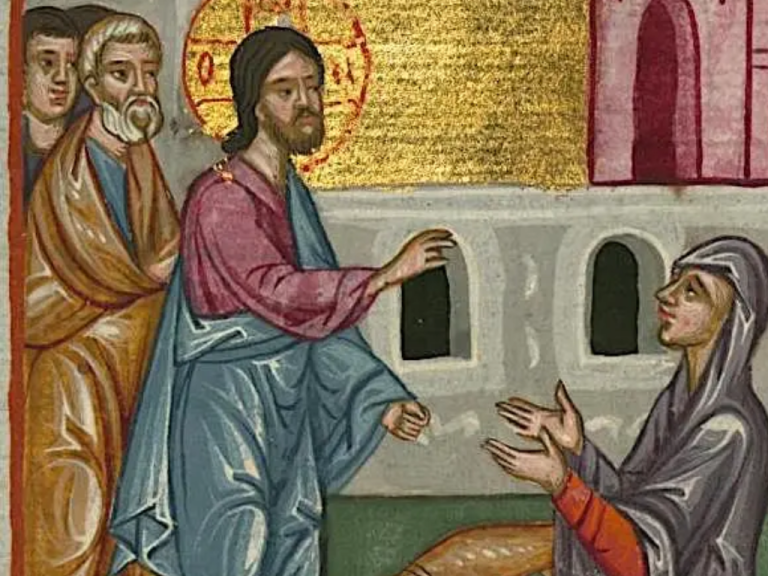
A sermon on Matthew 15:21-28 preached at St. Andrew’s Anglican Church in Hay River, NT
I want to begin this morning with a question.
What do you think you deserve from God?
Not what you hope for from God. Not what you’re asking God for.
Not what you think you need from God.
What do you think you deserve?
Because most of us, if we’re honest, have an answer to that question – even if we’ve never actually said it out loud.
Maybe we think that we’re basically good people. We try our best, we come to church, we pray, we give, we help other people – and somewhere deep down there can be this sense that, surely, God sees all of that and owes us something in return.
Or maybe we’re on the other side of it.
Maybe we know our failures all too well. Maybe we’ve made mistakes we wish we could undo. Maybe there are things in our lives that we’re ashamed of, and somewhere deep down we’ve decided that whatever God’s grace might mean for somebody else, surely it can’t mean that for us.
One says, “I deserve God’s favour.”
The other says, “I can’t receive God’s favour.”
And the Gospel this morning says both are the wrong perspective.
Grace begins where deserving ends.
That’s what I want us to see in the Gospel this morning.
Grace begins where deserving ends.
This morning, we see Jesus continuing on His journey, moving now through the region of Tyre and Sidon. These aren’t Jewish towns, they’re about 50 kilometers north of the border; wealthy towns with big ports that bring in a lot of money through trade.
Kind of like Samaria, this is not a place that most Jews think highly of.
And here, in this foreign city, there’s a local woman who hears about Jesus and tracks him down.
And it’s pretty clear – she hasn’t just heard about the miracles, she’s not one of those who just came out to see a good show. She knows who He is.
What does she cry out?
She calls Him “Lord”, she calls out “Son of David” – a title that means Messiah, the anointed, promised one.
To call Jesus “Lord”, to cry out for mercy, to be literally seeking and following Him – tracking Him down – those are all outward and visible acts of faith, all good things.
But let’s stop and think about what happens next, and what it means for us in our own journey.
Matthew 15, verse 23.
This woman has tracked Jesus down. This woman has called Him “Lord”, and has cried out to Him for mercy.
And how does Jesus respond?
This is challenging for us, but what does it say?
“Jesus didn’t answer her.”
Now, I know what some of us are thinking.
‘Wait, what’s going on here? That can’t be right! The Bible says that whosoever calls upon the name of the Lord will be saved – seek and you shall find, knock and the door shall be opened. This woman did the right thing, why didn’t Jesus respond?’
This is the hard, gospel truth for us to grapple with this morning.
This woman has cried out to Jesus, has confessed Him as Lord, but let’s be clear: these are not magic words.
Scripture tells us that God’s ways are higher than our ways; that we look at the outside, we see the actions, but God looks at the heart, the intention and the attitude behind it.
Looking back at the Gospel lesson – Matthew 15, verse 23 – Jesus doesn’t just answer her. He doesn’t just mechanically respond to the right words being said.
No, instead, Jesus – the true, merciful, and righteous judge, the one who will come again to judge the living and the dead – He challenges her to think about how she sees herself.
He says to her, “I was sent only to the lost sheep of Israel”.
Now, to be clear, He’s not talking about a particular political country, or a certain race. He’s talking about spiritual Israel – the people of the covenant, the chosen ones that God called to be a light to the nations, for His glory. Maybe another way to put this is, “you said the right words, but why are you here?”
How does she respond? Does she turn away?
No, she comes even closer, and falls on her knees… and we see something beautiful.
Not demanding, not claiming that she deserves this or that; no, she takes that position of humility, and asks simply for mercy.
Does she deserve anything from Jesus?
This might sound harsh, but no, she doesn’t deserve anything from him. Even if she recognizes Him as the Messiah and calls Him Lord, Jesus doesn’t owe her anything. As Romans 11 says, “who has ever offered something to God that God owes back”, as though He could owe us a debt.
She does the outward action of falling down in humility, but Jesus presses on, to reveal the heart.
He says “it is not right to take the children’s bread and throw it to the dogs”.
It’s a shocking thing to say. In fact, to our modern ears, it might sound downright de-humanizing. Maybe it’s hard for us, really, to hear Jesus speaking this way.
But let’s unpack that.
The way that Jesus pushes her to think is no small thing, and the answer matters, because it reveals whether we believe we deserve anything from God. Like a child, sitting at the table, fists on the table, saying “where’s my food?”.
What He’s saying is: ‘Do you think you have the right to demand this, that you’ve earned something, that God owes you something that you can claim? Or do you acknowledge that you are entirely dependent on God’s undeserved, unearned, unmerited grace – freely offered and freely given, but not something that anyone can ever claim or demand as their own, because from God’s perspective, all of us stand guilty and in need of forgiveness, none of us are children of God by birth, none of us can claim a seat at the table by right, but only by the adoption of God in Christ, only by His grace and mercy.’
…and, what does she say?
“Even the dogs eat the crumbs that fall from their master’s table”.
Wow.
That’s it.
It’s not about grovelling or putting ourselves down or seeing ourselves for less than we are.
No, but it is about realizing that grace can only begin where the sense of deserving ends.
You want a seat at God’s table?
You can’t earn it, you don’t deserve it, it isn’t yours to claim.
None of us – not me, not you – none of us deserve to eat that bread and drink that cup, to share in the eternal life of Christ.
But, by God’s mercy – when we bow down and, in the depths of our heart, acknowledge and accept our powerlessness and live into that reality of our total and utter dependence on God, then it’s in that moment that everything changes.
It’s in that moment of saying “Lord, I am not worthy” that God says “you’re right… and my grace is sufficient”, and reaches out that hand of mercy and lifts us up and clothes us and gives us a seat at the table, as a son or a daughter.
We don’t need to plead our case.
We don’t need to justify this action or that attitude, to tell God what we’ve done to deserve his favour.
No, we simply need to be honest about who we really are – as those unworthy to demand anything from the Lord; and in that moment, we find grace.
My friends, that’s good news, Amen?
But how many of those outside the church know that good news?
How many do you know who have it backwards, that they have to get their life in order, get their life straightened out, and then they can come to God and God will owe them a seat at the table?
People are going through life, relying on themselves in the good times, grasping on to bitterness or addiction or whatever they can cling to in the bad times, thinking they don’t deserve the grace of God.
And I know it takes a lot of boldness to speak up.
But the message to them is simple, and it’s the message from our Gospel reading today.
It’s the humble and humbling message that, actually, no, you don’t deserve the grace of God.
You don’t.
And I don’t either.
But, when “deserving” ends, if we accept grace as a free gift, totally undeserved, then He meets us where we are.
He doesn’t leave us as one looking for crumbs under the table; no, He lifts us up, and offers us more than we can ask or imagine…
…and all for His glory, now and forevermore.
Amen.

