What is faithfulness?

The story of King David always strikes me as heartbreaking.  On one side, it’s a story of absolutely inspiring faith: a shepherd boy with a slingshot who sends the opposing army running, in the name of God.  A man who is willing to wait for God to work things out rather than cooking up his own plans to unite the kingdom of Israel.  A man who accepts when God’s answer to his prayer is “no”.

But David – this great example of faith – had a hard life.  Think about that: King David is an example of what it means to have faith in God… but at the same time, no one would suggest that we should live as he lived.  After all, this great example of faith found himself burning up with lust to the point of murder, and his adultery became a public scandal.  Sure he had a palace, but this no fairy-tale, and there’s certainly no happily ever after. 

David’s life was thoroughly human.  He was kept from reaching his early potential by Saul’s jealousy.  He faced 7 years of a political smear campaign by his rival.  He knew that unspeakable pain of a parent who loses a child.  And a few years later, he knows the distress and anguish of a parent whose child rebels against them, as his son Absolom works to tear down everything his father had built.  And after all that, David’s closest friend and advisor is the one who kills his son, as David grieves as one who had never made amends for that broken relationship.

David’s story is heartbreaking.  And it breaks my heart because David’s story is like so many stories.

What is faithfulness?

David’s story should challenge us.  How can it be that one of the great examples of faithfulness lived a life that none of us should emulate?  How can that be?

This is where so many have missed the point.

So many open scripture looking for an instruction manual on how to live: do this, don’t do that, earn your way to heaven. But that’s not what it’s all about.  There’s no hope in that twisted half-gospel.

The message of scripture – and the hope that we share – is this: it is not about what we do; it’s about who we are

God is not a “what”, a thing for us to grasp or understand.  God is a who – a living being with whom we can have a relationship.  Faithfulness is not a list of what you’ve done; faithfulness is about how you answer the question “who am I?”.

That’s where David is an example to us: he honestly tried to do right, but it didn’t always work out, and sometimes it failed disastrously.  But “God doesn’t look at the measure of a man”, God looks at the heart.  God doesn’t weigh out what you’ve done, good versus bad – and that’s good news, because the truth is that none of us would make the cut if we had to earn God’s love.

No, God looks at who you are.  Are you a person who seeks to love God and neighbour but who realizes you do fall short and always need God’s mercy in Jesus Christ, or are you a person who will stand before God and say “I’ve got this: give me what I’ve earned.”

You see, that’s the big difference between King Saul and King David.  King Saul trusted in himself – he was king, he believed he won the battles: he earned this throne, and it wasn’t for God or anyone else to take away. 

But David was a man of faith.  He knew that, even in the face of incredible, heartbreaking pain, everything we have is a gift, and no matter how bad the situation, it will always be better if we return to God and beg for mercy than if we turns our backs and go our own way. 

Now, does that mean it was easy?  No – because we don’t believe in magic.  Life is messy, decisions have consequences, and at the end of the day, God’s promise is not that we will be happy and healthy and wealthy in this broken world.  God forbid.  Anyone content with this broken world has their eyes closed to the pain of those around them.

No —God doesn’t promise that life will be easy for those who have faith.

But he promises something far greater.

As David wrote: “even though I walk through the valley of the shadow of death, you are with me; your rod and your staff guide and comfort me”.

God’s Presence with us

Life is hard.  Families are hard.  Sickness is hard.  Losing friends, and watching kids walk away is hard.  Acknowledging our own brokenness is hard.

And it’s normal to wish we could go around the valley, or build a bridge over it, and sometimes people just give up and sit, stuck, afraid of the thought of moving forward.

But the path to life leads through the valley.  And as much as we might wish it was otherwise, God doesn’t say “I’ve got a shortcut”. 

But what he does say is so much more amazing: He says, “I know you have to walk through this valley… but I will go with you. 

…Will you go with me?”

That’s the incredible truth we proclaim. 

God doesn’t say “stay positive, think happy thoughts”.  God doesn’t say “do me a favour and I might show you a shortcut”. 

No, God says “I will never leave you nor forsake you”.  Will you walk with me?

And it’s not about what we do – not that actions don’t matter, but because we all fall short.  It’s about who we are.  Are you one who says “God, I need your help.  I’m mad, I’m sad, I can’t do this on my own: walk with me”.  Or, are you one who says “leave me alone, I’ll go my own way”.

God looks at the heart.  And the incredible thing is that God knows we’re going to get stuck.  He knows we’re going to get distracted as we go through the valley.  He knows we’re going to make some wrong turns; that we’re going to get upset and yell and wish there was another way.  He knows… and he’s still willing to walk with us.  No matter how far we’ve gone in the wrong direction, He doesn’t run ahead.  No, he turns back to reach out and help us.

This Advent, let’s remember that’s the story of Christmas we’re here to proclaim.  God loves us so much that he’s willing to share our mess.  He wants to show us that he knows our heartbreak; that he knows what it is to face jealousy and lies, to know the hardship of broken families, to know the pain of grief and sickness.  God even knows David’s pain as he watches his own son die because of the brokenness of this world. 

And yet God’s message is “I want to be with you.  Will you walk with me?”

And, my friends, there’s no way around the valley – I often wish there was.    But God knows that what awaits on the other side is far more glorious than we can even imagine.  He will wipe away every tear, death will be defeated, and pain will be no more. 

But we’ve got move forward to get there.  And, as we see in David, it’s not a journey that we can ever do alone.  But God himself is standing right beside you, ready to lead you and comfort you, ready to let you take off whatever weight is on your back, and carry it for you so you can look up and see the light.

God says, “I will be with you”.  Will you be the person who says “I’ll go it alone”, or will you be the person, no matter what you’ve done before, who says “Lord, I need you – walk with me.”

Almighty God, we need your presence in the darkness of this world.  We can’t face the journey alone.  Stir our hearts to cast our cares upon you, to be still and know that you are God, and to know that – whatever pain we face – it will be well, because you are alive and you go with us.  We ask this in Jesus’ name.  Amen.

David: Trusting God’s foolish solution.

For it is written, “I will destroy the wisdom of the wise, and the discernment of the discerning I will thwart.”

I want to do something a little different this morning.

I want you to put yourself in the sandals of one of those Israelite soldiers.  Just imagine with me – maybe close your eyes if it helps you put yourself in their place.

It’s late Spring – the time when kings go to war.  A messenger came to your town calling for every family to send their young people to fight for the king.  You left home with a sharpened pickaxe, the only pointed tool you could find.  You marched for miles over mountains and through valleys with your homemade sandals on your feet, a bit of grain and a skin canteen of water over your shoulder.

You’re following the king.  Saul is his name.  He’s a mighty man – feared through all the land, not least because he would kill your family’s livestock if your father hadn’t sent you to fight.  He’s an impressive man, a battle-hardened warrior who stands a head above everyone else in Israel.  You do as you’re told, following the king into battle.

But there’s rumblings in the ranks.  The king and his closest advisors have been at odds with the prophet – and Israel is weak.  The Philistines have armor and trained warriors, but you’re just a farmer with a pickaxe.  Israel needs God to fight it’s battles, but that doesn’t always work out.  You see, sometimes – well, a lot of the time – the king rushes in.  Saul’s impressive; Saul’s mighty; but Saul is impulsive, and you’ve heard he has these fits of madness.  And you and your comrades on either side are fully aware that Saul loses as many battles as he wins.

You’ve marched to the battlefield, setting up your tent as spring turns to the dry heat of the middle eastern summer.  On the other side of the valley are the Philistines – an incredible force, better prepared in every way.  In fact, they’re so confident that they don’t even want to waste their energy fighting – after all, it’s better to keep young men as slaves than to waste them on the battle field. 

Every day they send out their strongest warrior to taunt you.  And it works.  Can you imagine?  You’re a farmer barely 5 feet high, and you’re supposed to fight a trained warrior in bronze armor as tall as a basketball player, with a sword heavier than you could lift?  And you’ve heard the rumors in the camp – they’re all as strong as he is.  Everyone’s given up hope.  There’s no use.  You might as well go back home and prepare for life as slaves, growing your wheat to feed the Philistines while you live off the scraps. 

You look to the king – he’s easy to spot, he’s stands a head above everyone else.  He’s got the best armor, and even he’s shaking in his boots. 

Each day, the Philistines get up and start their battle cries.  Even the sound of their voices and drums and trumpets strike fear in your heart.  Then Goliath comes out.  He struts back and forth, your comrades drawing back every time he changes direction.  He doesn’t even want to fight – he just yells insults.  And, you’re ashamed to admit it, but maybe what he says is true.  You’re not strong.  You’re not mighty.  You’re just a farmer.  Goliath calls upon the names of his gods and curses you.  “Where is the God of Israel?” he shouts, as you hear the Philistine army behind him erupt with laughter.  “We have our god made of stone, but has anyone even seen the God that Israel thinks is on their side?”  After all, you remember, God used to go with you into battle with the ark of the covenant, but your grandfather was in that battle when it was lost. 

Forty nights you lie in your tent, listening to every sound, waiting for the Philistines to run you through.  Then you awake, hardly rested, to hear them laugh and taunt you, as even the king quakes with fear.  Why can’t they just get it over with?  If they’re going to kill us, why must they humiliate us first?  If they’re going to make us slaves, let’s just get it over with.

But what’s this? 

There’s a kid.  Look at him – he’s too young to grow a beard.  Who is he?

Look!  He’s breaking the line – he’s going out on the battlefield.

Somebody stop him!  He’s not even carrying a shield.  This is insane.  No, worse than that, this is embarrassing!  Listen to the Philistines – they’re roaring with laughter.  Come on, guys, somebody call him back.  This kid is going to get ripped apart.  They’re mocking us!

Wait.  He’s yelling.  …Oh, somebody stop him!  It’s bad enough Goliath mocks us each day, now we’ve got this kid out there ranting about God – a God we can’t see, who hasn’t come to help us these last 40 days.  Ugh, somebody make him stop.  Can’t anyone see how embarrassing this is?  I’m ashamed to be here with this army, let me go and be a slave to the Philistines.

For it is written, “I will destroy the wisdom of the wise”. 
…Has not God made foolish the wisdom of the world?

We all know the story of David and Goliath. 

But put yourself in the sandals of those Israelites.  Be honest.

Would you have trusted in David when he stepped out in that field?

Would you have opened your ears and listened when David spoke about the power of God, or would you have wished someone would stop him, that he would just shut up?

I am a faithful believer in Jesus Christ.  I am a priest of the Church.  But I have to admit: I wouldn’t have trusted in David. 

And I don’t think I’m alone in that.

The Season of Preparation

Advent is a season of preparation.  Not a preparation for Christmas – God knows we don’t need any help or encouragement to spend money or bake cookies or eat too much and enjoy a nice holiday nap! 

No, Advent is a season of preparation for the coming of Christ; and, with that, a season to prepare ourselves to meet our maker whenever that time comes for you and for me.

But the hard truth is, I don’t think any of us would have been encouraged when we saw a shepherd boy with a sling walking out to what would surely be his death.  I don’t think any of us would have stirred with religious fervour when, after 40 days of quaking with fear, we heard this young man talking about God’s glory.

But that’s the message of God’s story.

God will not save us in a way that preserves our pride.  God will not save us in a way that we can pat ourselves on the back and say “Wow, didn’t I do well today”. 

No.  God will save.

God doesn’t ask for your strength; he doesn’t ask for your wisdom; he doesn’t ask for your power; he doesn’t even ask for your opinion: he asks for your trust.

And let’s be clear – that means trusting in some incredible things. 

All of our instincts say “this boy, David, is a fool”.  But what we don’t know is that God has already anointed him as king.  We need to be willing to trust in the solutions that  God has provided, not cast them off because we can’t see how it will work.

When we’re feeling overwhelmed, worldly wisdom tells us to retreat into our houses; cut yourself off from the world, put on a mask – a happy face – think positive, and bear it yourself.

But God says ‘When one is weak, when one is sick, when one is mourning, when one is simply worn down: take it to the church.  Bear one another’s burdens, pray for one another, be anointed for healing, taste and see that the Lord is good.  But we say “it’ll never work.  I need to do this alone”, rather than trust the solution that God has prepared.

When our minds are swirling, when we’re frustrated, when we just can’t figure out what’s going on, we say “where’s God?”.  But God says “faith is a gift”… but you’ve got to open it, you can’t leave it wrapped up under the tree.

When a sickness is spreading, when the waters are rising, when the mountains are literally toppling into the sea – yes, God has given us amazing minds and skill to create vaccines and levees and helicopters to evacuate those stranded by floods – but do we put all our faith in those man-made solutions, or do we use the gifts God has given us, and then turn to God in prayer?  Trusting that, though prayer might feel like a strange waste of time, the same God that sent a boy to defeat the Philistines also said that more is accomplished by prayer than this world will ever know.

Come, Lord Jesus

This advent, I need to be honest with myself.  I wouldn’t have trusted in David.  But, by the same token, what other incredible solutions does God have planned that I’m simply unwilling to accept?

This Advent, I invite you to reflect and prepare for the day that we will each meet God face to face, and with that, to pray for open eyes, that we may see that the God who raises up the humble and meek will do the same for you, and for me, if only we trust in the one whose wisdom passes all human understanding.

To Him, and to him alone, be the glory, now and forevermore.  Amen.

Christ the King?

The people wanted a king.

Sure, God had rescued them from slavery.  Sure, he had done what they could never do for themselves, overcoming the mighty Egyptian army.  Sure, he had provided his people will food that they never planted or worked for, and gave them water from wells that they never dug. Yes, he heard their complaints and listened to their fears and struggles, responding far more patiently and generously than they deserved.  Sure, he led them victoriously in battle when they were overwhelmed and ill-equipped.  Yes, he had set up a system of government for his holy nation, a society where there was provision made for the poor and the widow, for the sick, and even for the foreigner who reaches out for help.

Yes, yes, yes: God did all that. 

But the people wanted a king.

You see, Israel was supposed to be different.  All the other nations had kings – mighty men with impressive houses, strong armies, and large storehouses in which to put your trust.  All the other nations had a face they could put on their battleshields and on their coins, they had images and statues they could look up to; works of stone or iron or bronze that gave the illusion of strength.

But Israel was supposed to be different.  The message of God, going right back to that starry night when God invited a childless Abraham to trust in him, is at once radical and incredibly simple: ‘don’t trust in your own strength; don’t lean on your own understanding; don’t depend on your own plans, for you don’t know what tomorrow will bring.  I will be your God, and you will be my people.’  The message of God is simple: trust in me.  God says, ‘let me be your Father, and I’ll adopt you as my own; I’ll provide more than you even know that you need’.

God calls out through the ages: ‘If I say the fruit on the tree in the midst of the garden will hurt you: trust in me.  If I say family is important and you are your brothers’ keeper: trust in me.  If I say I have a plan to free you from whatever enslaves you: trust in me.  If I say ‘go forward through the water, it will be ok’: trust in me.  If I say I will not provide all you want, but I will provide what you need: trust in me.  If I say ‘come to me as beloved children and open up about your fears, for I will strengthen and save you: trust in me”.

The message of God is unchanging through the ages.  He calls out to all people. 
…but the people wanted a king.

Part of God’s Plan

As we read in Samuel, Israel finally recognized that they wouldn’t put their trust in an Invisible God.  Even after all that God had done, they knew their eyes and their hearts would continue to lead them astray.  If they were going to be united as a holy nation, they told God’s prophet that they would need a human king.

Now, they already had a king – the king of kings, who went before them in cloud and fire and who led their armies into battle, seated above the ark of the covenant.  But, in a moment of incredible self-awareness, Israel finally admits that they’re prone to wander, that they want a person in whom they can put their trust.

Now God, as we would expect, is disappointed: you’d think that providing heavenly bread in the desert and knocking down city walls with nothing more than a trumpet blast would be enough.  Ideally, they would have faith enough to see the Invisible God leading Israel. 

But even when God is disappointed, He’s never surprised.

You see, Israel has forgotten, but we know a man was part of the plan from the beginning.

Right from that day of disobedience in the garden, what was the promise of God when he cursed that lying serpent?  The son of man will (do what?) crush the serpent’s head.

Israel had forgotten.  They thought a human leader was their idea.  But from the very start of humanity’s troubles, God promised that it would be the son of man who would free them from the devil’s lies.

That’s why, from the very foundation of the world, God had planned for his Son to take human flesh, to live and die as one of us, to be for us the image of the Invisible God, to be the king who is high and lifted up as he does what we could never do for ourselves, as the king who reigns from a tree, a king who offers himself as sacrifice for the freedom of his people, and in so doing destroys the selfish, self-centred, self-trusting power of the grave, if only we’re found to be trusting in him rather than clinging to our own false sense of power as it leads us to destruction.

Israel already had a king. 
The problem was never the lack of a king… it was a lack of faith.

They wanted someone to defend them in battle.
They wanted someone to provide what they needed.
They wanted someone to hear their complaints when they were distressed.
They wanted someone to guide and direct their lives together.

They already had a king – but they couldn’t bring themselves to trust in him. 
They couldn’t bring themselves to trust in one so radical that he would call a childless nomad to be the patriarch of his people; that he would call slaves to be a holy nation; that he would call a man with a speech impediment to be his spokesperson; that he would call a prostitute to protect his holy ones; that he would call – again and again – the lowliest member of the weakest tribe to be his chosen leader; that he would cast off those who thought they were mighty and of noble birth, only to welcome in strangers and foreigners who came in faith.  They couldn’t bring themselves to serve the God who says ‘I will drive out your enemies, but don’t dare collect their plunder’; the God who says ‘I’ll fight your battles, but send your soldiers home, and take trumpets, not swords, because you can’t trust in yourselves and call it trusting in me. 
You can’t trust in yourselves and call it trusting in me.

The Church and the Reign of Christ

Israel wanted a human king.  Someone they could rally around.  Someone they could complain about when things weren’t going the way they wanted.  Someone they could look to and say “that’s his job”.

But, as we know, God’s people would go to the grave still refusing to accept that theyall of them – are a royal priesthood; that all of them, together, are the royal family of God, imbued with the responsibility to accept the work they’ve been given to do.

Instead, they wanted a king to look to. …And how often does the Church do the same? 

Each of us are called to be messengers of that Kingdom.  Each of us are equipped and given the words to simply and clearly reach out to our friends and family and invite them into the kingdom of God; but how often would we rather grumble, and wish we had some great leader to rally around, as our grumbling – whether it’s over bake sales or which pew we sit in – only sends people away. 

My friends: the Lord is King.  He has provided all that we need – I mean, seriously, it’s a pandemic, and we have the highest offering in years, and have a surplus in our budget even in the midst of a renovation that we only did one fundraiser for!  God heals – we’ve seen lives changed through Celebrate Recovery and Grief Share.  God opens our eyes when we ask him – we’ve seen incredible learning and growth; we’ve even seen minds blown as people read the scriptures with an understanding that they’ve never had before.  And we’ve known the comfort of God, as God proves time and time again that he is gentle and kind when we stop pretending and finally pour out our hearts to a loving Father who runs out to embrace us. 

The people wanted a king… but God had given them Himself.
The people wanted an army to lead the way… but God said “you are my people; follow where I lead”
The people want a sure sign of God’s presence… but the God who chooses the weak and humble said “I have put my word on your lips – I’ll go with you”.

The world looks for kings to rally behind.  But Israel was to be different – a nation in whom God’s power is shown in spite of their weakness.

The message of God, going right back to that starry night when God invited Abraham to trust in him, is at once radical and incredibly simple: ‘don’t trust in your own strength; don’t lean on your own understanding; don’t depend on your own plans, for you don’t know what tomorrow will bring.  But, I will be your God, and you will be my people.’ 

God says, I will be your king, but better still, I will adopt you as my own.  I will put my Son on the throne, and you will be my royal family, with all the rights and responsibilities that go with that.


The one true king is known as the good shepherd, who leaves his throne to get his hands dirty with wayward sheep; the one true king fulfils the promise made in the garden, crushing that serpent’s head; the one true king comes among us as one who serves, offering himself as a sacrifice to redeem us – to buy us back – from whatever we’ve sold ourselves to. 

But we can’t trust in ourselves and call it trusting in him.

May God give us the faith to see God at work in our lives, to accept the work he’s given us to do, and to put our trust in him, now and forevermore.  Amen.

Chapter 9: Ruth from Moab — a bizarre twist!

Almighty God, give us grace to boldly speak of your amazing love. In Jesus’ Name.  Amen.

As we’ve been journeying through the Story together, with the goal of understanding the whole scope of God’s plan from Genesis through Revelation, this week brings us to the story of Ruth.

In some ways it’s the easiest episode so far: the chapter was only 7 pages, there’s really only three characters, and it’s a pretty simple story of people showing kindness even in adversity. 

But, we have to be careful not to read it as a self-contained story; like everything else we’ve read this fall, we see it in a new light – we see so much more depth – when we see how it connects to the ongoing work of the one true God who is the same yesterday, today, and forever.

Moab: A bizarre twist

If we stop to think about it, Ruth should strike us as a really weird story.  Maybe we’re too familiar with it to really be struck with just how bizarre this story really is.

Israel has strayed once more.  God had been raising up judges to guide his people, but his chosen family – called to be a holy nation – were doing just the opposite.  They’d forget the covenant, they’d fail to teach it to their children, they weren’t strong and courageous, and soon enough they’d find themselves worshipping gold, or bronze, or carved stones, running from temple to temple – not to worship, but to find bodily pleasure.

Israel has disobeyed to the point that the promised land – that land where they would eat milk and honey without toil – had dried up.  This is no accident: this famine, like several we’ve read about before, is meant to remind God’s people that we don’t and we can’t ever rely on our own strength; no matter what, we must acknowledge that it is God alone who provides.

And in that famine, a family – a man named Elimelech and his bride Naomi – leave home from Bethlehem, and seek food elsewhere. 

But they don’t go just anywhere.  They go to Moab.

And if we think back to the earlier chapters, “Moab” should ring a bell.

Moab is not a happy place. Moab is not the sort of place any Israelite is eager to be found.  Israel and Moab are enemies, and have been since Israel first avoided walking through their land after the Exodus, generations before. 

Balak, we read earlier, was the king of Moab who hired a prophet to curse Israel (you might remember the whole talking donkey incident that followed!).  And then it was Moabite women who overcame the Israelite army by leading the young men astray.

More recently, during the time of the judges, Moab had taken Israel hostage for 18 years, as Israel forgot the God who led them miraculously out of Egypt, and turned themselves over to be enslaved to someone else.

Things are so bad in Israel, that Naomi’s husband goes there

The God who Redeems

But, God is faithful, and his perspective and knowledge of the big picture is far beyond what we could even imagine. 

From any one human perspective, we might not see how God is working out the salvation and redemption and restoration of humanity, but we can rest secure in that fact that, if God said to Adam and Eve that the son of man would one day crush the serpent’s head, he’ll do it. 

And, what was the promise made to Abraham?  Yes, he would have land and he would have many offspring.  But, much more importantly, God promised that through Abraham, through Israel, all the earth would be blessed. 

And God doesn’t forget his promise… that’s the central message of the book of Ruth.

A blessing to all nations

Sometime during the famine – scripture doesn’t give us all the details – Israel returns to the Lord, and God provides food for his people.  It’s such a big deal that word spreads to the surrounding countries, and all to God’s glory. 

Even over in mighty Moab they hear that the God of Israel has miraculously intervened.

Naomi, a helpless widow, is going to pack up and go home – surely some relative will take her in.  But those two young widows, her daughters-in-law, they’re free to stay.  They’re not Israelites, they’re Moabite women.  Naomi certainly can’t provide for them; and their husbands were born abroad – it’s not like they have any friends back in Bethlehem. 

But, having heard of God’s provision, and having seen the example of Naomi’s faith even through the death of her husband and her two sons, Ruth has made up her mind: she’s not going to do what was socially expected; she’s not going to do what was easy; she’s going to journey with this helpless older widow, and she’s going to put her trust in the God of Israel.

Now, with all of that background, maybe it’s becoming a little more clear as to why Boaz is hailed as being exceedingly gracious and kind.  Young Ruth isn’t just any widow gleaning in his field: this is a Moabite.  ‘We hate Moabites’.  ‘Moabites curse Israel.  Moabite women were the downfall of our army.  Moabites enslaved us for 18 years!’  And here she is in our field? 

Yes, says Boaz, and make sure she’s well provided for.  Don’t send her around to another field – they might hurt her.  Out of a famine, God has provided overflowing storehouses and leftover food on tables – let her take some home.

…and as we read this, the bells should be ringing in our ears: God’s promise and God’s desire is not just to bless Israel.  God’s plan is to bless all nations.

As they hear of God’s glory they will turn from their idols, they will turn from trusting in the might of men or swords or the size of their storehouses, and they will come and worship the one true God who created heaven and earth, and they will be blessed.

And what follows then for Ruth, as odd as the details of an arranged marriage may sound to our ears, is a story of adoption.

Ruth, who sought to follow the one true God – even though she’s a Moabite, an enemy of Israel – is adopted into God’s family.  She’s no longer a stranger, no longer a foreigner dependant on the charity of others. 

No, she sought the God of Israel, and she was adopted into the family of God’s people. 

And then, in the biggest twist of all, God makes an incredible statement.  Yes, God had called Abraham and his descendants to be his people.  But the promises aren’t inherited by blood – Abraham had faith, and that was accounted to him as righteousness.

Israel was born into these promises. But, to remind us that it is by faith, not by birth or anything else, God adopts Ruth, a Moabite woman, into his family.

And Ruth has a child.  And, tell me, who is Ruth’s great-grandson? 
King David, who defeats the Philistines and brings peace to Israel.

God, by faith, adopts a Moabite, makes her part of his story, and uses her faithful offspring to do what faithless Israel hadn’t been able to do before.

…But the Word of God doesn’t just promise to bless the nations.  He promises to crush the serpent’s head when He takes up residence among us as our friend and brother, the son of man: Jesus, the descendant of David. 

Ruth, a Moabite widow, a helpless foreigner, becomes the ancestor of Jesus: through whom, death, sin, shame, and all the devil’s lies are crushed through the one perfect sacrifice of the Son of God.

It’s an incredible story.

…but how did it all start?  What made it all possible?

Word of God’s goodness reached Moab.

Ruth couldn’t believe unless she heard.  There needed to be those thousand tongues telling of God’s goodness to all people; there needed to be prople willing to sing of those 10,000 reasons to bless the Lord. 

Friends: there are people all around us who worship all sorts of gods.  People all around us who have pledged themselves to all sorts of idols that they think can give them fulfilment, or can take away – or at least numb – the hunger that they have inside.  God’s desire is to bless all nations, but he’s calling you to be part of that. 

That doesn’t mean you have to be a missionary or hold up a sign on a street corner. 
No, not at all.  What it does mean is that, when God provides, when God gives comfort, when God proves that his wisdom is better than our wisdom, we have to be quick and bold to give him the glory; He’ll do the rest, as he did with Ruth. 

Whoever first spread that news that God had provided food would never know what God had planned… just like you and I can never imagine what God has planned for the poor widow across town, or the struggling kid across the street. 

But that’s not for us to figure out!  God will adopt any who come to him in faith. 
But they need to hear before they can believe – they need those thousand tongues to sing 10,000 reasons to bless the Lord.

And that’s the work he’s given to us.  May he make us bold: for, like Ruth, we’ll never know what incredible things God has in store, if only we’re ready to give him the glory, now and forevermore.  Amen.

A New Command: Be Strong and Courageous

We pick up this morning at chapter 8 of The Story

God has shown his mighty power in delivering his people out of slavery in Egypt, across the Red Sea, and provided everything they needed to get to the Promised Land.  How did that generation respond?

They grumbled and complained.  They looked across the border, saw their enemies, and believed their doubts rather than trusting in God.

That generation wandered in the wilderness, until their children grew up and took their places.  Joshua became the leader in place of Moses, and they trusted; they entered the promised land, and were victorious in everything God gave them to do. 

God fulfilled his promises in greater and greater ways.  And I don’t know if you picked up on this in the story of Joshua and all that follows, but there’s an important point to tuck away in the back of your head for everything we’re going to read between now and Christmas. 

God told his people to be holy: to be set apart for his glory, to be holy people – to be sanctus (is the Latin word); to be saints

How do they do that?  Well it’s actually quite simple – God said it straight up when they were at Mount Sinai: be holy – be saints, is our English word – by keeping my commandments and remembering my testimony; or, in other words, the saints are those who live as God directs (which means asking for forgiveness when they mess up), and telling the story of God’s mercy, love, and power. 

And it’s important to point out that, when God makes a new covenant with Joshua and his generation, God adds something new.  It’s a phrase repeated at least 10 times in chapter 7, a phrase that is key to overcoming their enemies, to knocking down the walls of Jericho, and inheriting the land God had promised to them.

Let’s see if we remember… Joshua said to them, “be…” (what was it?)
Be timid?  Be insecure?  Be weak? 
No!  What was it God said?  “Be strong and courageous”

Be strong and courageous because the Lord is with us.
Be strong and courageous because the Lord has given them into our hand.
Be strong and courageous because the Lord will finish what he started.

That’s the key to living in the promised land.  Live as God directs (“keep my commandments”), keep telling the story (“remember my testimony”), but to cap it all off, be strong and courageous!  Live as those who know that God does keep his promises, and does defend those who trust in Him.

…Pretty straightforward, right? 
And that brings us, then, into chapter 8 where we see the exact opposite. Chapter 8 begins the long and sad story of a people who forget God’s testimony, who set aside his commandments, and who – more often than not – cave and cower in fear almost every time they need to have a little faith.

The Judges

In Chapter 8 we saw snapshots of those who trust in God – those who were strong and courageous – side by side with those who didn’t, who trusted in worldly wisdom and found themselves crushed under the weight of the world, as happens every time. 

There’s some fabulous characters in there: Othniel the warrior who was the grandson of one of those original spies sent into the promised land; Ja’el, that courageous woman who drove a tent peg through the head of an enemy king to prove that God’s power can be shown through mighty women; Gideon the reluctant leader who took the time to make sure it really was God who was speaking to him; and the graphic depiction of a king so large that a sword got lost in amongst his rolls.

So many directions we could go, but in the big picture, the thing that ties it all together is God’s command: keep my commandments, remember my testimony, be strong and courageous, and I will be with you.

That’s what ties all of these together: when they do those things, God is with them to provide what they need; when they go their own way, they realize just how weak they are on their own.

Ignorance or Disobedience?

The big take away from this is a simple but earth-shattering message.  God has revealed himself to the Israelites.  And that changes things.  From God’s perspective, there’s a distinction between ignorance and willful disobedience.

God goes out of his way, again and again, to reveal himself to those who do not know him, who have not heard about his love or his power.  And, as much as God is always ready to forgive, when he’s revealed himself but we then choose to disobey and go his own way, he lets us do that, even if the results are disastrous.

Let’s zoom in on the story of Samson.  Samson is the miraculous answer to the prayer of a barren woman.  An angel appeared to his mother and told her God’s plan, that her son would lead Israel in overcoming the Philistines who had made them slaves once more.

He was raised and became a Nazirite: that’s someone who make a special vow to live in a holy way in order to be an effective servant of God.  There’s three vows that they make: The first is to abstain from wine; the second is to have nothing to do with corpses or graves; the third is not to cut their hair.

Now, God have given Samson awesome strength; like the angel said to his mother, he was supposed to be a strong leader to free God’s people from slavery.

And I know it’s easy to get caught up in the fascinating details of Samson’s life, but, when you stop to think about it, how did Samson do with the work God had given him?  Or, how did he do with keeping his vow?

This is the part we overlook: In all that we read about Samson, we see that he’s violent and proud; he relies on his strength, and does incredible things.  But, when you go home, flip back through the story of Samson.  What’s missing compared to all the other leaders we saw so far?  Samson never spoke with the Lord

He was given a divine purpose, called to be another Moses to free his people from slavery.  He was given unique gifts that would help God’s people.  But he was so occupied with his own ambitions that he doesn’t stop to ask what the Lord actually wants him to do.

And, in the process, multiple times, he breaks his vows.  He, himself, holds a drunken feast in his honour; he doesn’t avoid corpses – he makes them, and then strips 30 of them off to take their clothes to pay others for losing his bet.

God had great things in store for Samson, but he becomes a blind guide (literally), and rather than freeing God’s people, finds himself enslaved in a prison workcamp.  He was meant to lead the Israelites to freedom, but, scripture says, he accomplished more when he died than in all the years he was alive. 

That goes to show that strong and courageous alone isn’t the key – it’s a package deal.  The holy people of God, the saints of God – you and I – have to keep God’s commandments, remember his testimony, and be strong and courageous.

No, my friends, Deborah is a better example: a faithful, wise, strong, and courageous woman who led all of Israel.  She didn’t rely on a palace with strong walls, or a mighty army of guards to be her protection.  Remember where she ruled from?  Under a tree! 

Those who rely on worldly wisdom will be crushed by the weight of the world. 
But those who keep God’s commandments, remember his testimony, and are willing to be strong and courageous will always find that God keeps his promises, that he will finish what he starts, and he will show forth his glory through his holy people, through his saints, even you and me.

And so, as St. Paul says, we’re not to run aimlessly; we’re not to throw punches into the air and call it boxing.  No, we’ve been given work to do – each of us – and we need to be strong and courageous, running forward, knowing that God is with us. 

And we can trust in that, even when our knees are knocking and we’re shaking in our boots.  We can choose to be strong and courageous even in the face of fear, because Jesus said that he knows his sheep, and no one will snatch them out of his hand – all it takes is for us to hear his voice, trust in the Good Shepherd, and follow him.

As we renew our baptismal vows and our commitment to be one of the saints of God, do so remembering all that you’ve read in his word this week:

What does God ask of us?

            Keep my commandments
            Remember my testimony
            Be strong and courageous

God will be with us.
God will finish what he starts.
And if we keep his commandments, remember his testimony, and be strong and courageous, he will be glorified in his saints… even you.

Amen.

Pharoah wasn’t the Problem

And Moses said: “See, I set before you today life and prosperity, death and destruction. … Now choose life.”

This weekend we’ve read Chapter 6 of The Story together, and it’s a doozie, isn’t it? It’s absolutely jam packed, one stunning thing after another.


God had kept his promises, He had shown his glory in bringing his people out of Egypt, and being among them in powerful ways like no one had ever imagined before. He promises to provide, called them to be his people, and asked in response that they would be holy – set apart – so that all the world would see his goodness and mercy and come to worship Almighty God alone.
For a year they camped out, learning what this holiness was all about, learning to trust God and worship Him. And then – this was it, the moment they were waiting for. It was time to enter the Promised Land. God was driving out their enemies before them… but that wasn’t enough to settle their rumbling bellies. They had set out to enter the land promised to their ancestors, but all they could think about was the great selection of produce back in Egypt; God is right there with them, but they’d happily trade God in for some quail, or cucumbers, or leeks, or melons. They would trade in God’s presence for a good meal.


And it’s funny how the memory becomes selective, isn’t it?


“Think of the great food we ate at no cost! It didn’t cost us anything!”.
Well, no, it didn’t cost you anything because you were slaves! We humans have this ‘skill’ to cling to something bad while talking ourselves into thinking it’s better than it was, don’t we?


And the rest of the chapter just went downhill from there. There’s a leadership battle, as Moses’ brother and sister become jealous of his position. The scouts sent ahead to check out the promised land don’t trust that God will help them in battle, so they spread a false report, and the people lose heart, right at the doorstep of their new land – they plot to replace Moses, saying they’d rather die in the wilderness than face the Canaanites.


And finally, that’s where God says “fine, I’ll do as you wish”.

Isn’t it strange how we tend to have learned that wandering in the desert to die was a punishment that God inflicted; but when we read the story and see the bigger picture, what we find is that it was something much sadder. Wandering in the desert until they died rather than facing their enemies wasn’t something God cooked up out of nowhere – no, it was exactly what they had asked for.


Moses, too, you might remember, had become fed up for having to nurse his people along like infants, and prayed that God would let him die rather than bear the complaints of his people. And, at the entrance into the promised land, rather than simply praying for water, he chose to be dramatic and strike the rock to make it look like a great magic trick so the people would stop complaining and trust him: but that’s not the kind of trust – or the kind of leadership – that God desires.

It was jam packed, wasn’t it! And there was more: more complaining, poisonous snakes, disease, politics, a talking donkey, and all the young men running off to worship another god because that god had pretty women working in its temple.

And so, the big point today is simply this: Perspective matters.

On the one hand we could say “is God angry? Why is He treating His people this way? I thought he loved them?”

But when we zoom out, when we know the whole story, we see just how inappropriate a question that is. God – the merciful and just, forgiving rebellion, but letting sin have its consequences – is recklessly patient. A dozen times He could have said, no, you know what, there’s a more obedient, less-stiff-necked option somewhere else; a dozen times He could have said ‘if you don’t want to be my people, then fine, go your own way’. But God sticks with them.

The problem though, when we zoom out, is that instead of using the law to become more like God, they’ve become more like pharaoh, haven’t they?

Every time they’ve seen God’s glory, they dug in their heels and hardened their hearts, choosing to focus on a problem rather than God’s solution.

Every time they experienced God’s forgiveness, rather than repenting – changing direction, fixing the problem, and doing things differently – instead they said, “oh good, God forgave us… but what about those cucumbers!” Or, “ooh, there are pretty women in that temple!”.

Perspective matters. And, if we look carefully, there’s a common thread woven throughout this story – and it’s one that applies directly to us today.

Pharoah wasn’t enslaving them.


Now, sure, when they were crying out in Egypt making bricks without straw, Pharoah sure looked like the problem. But that problem was dealt with. The Egyptians weren’t chasing them. They were free people now.

Pharoah sure looked like the problem at the start, but now it’s clear: they weren’t slaves to pharaoh. They’re slaves to sin. They’re slaves to the hardness of their own hearts. They’re slaves to selective memories, longing for what they don’t have, while happily throwing away the solutions that God has put right in front of their faces.

They thought they wanted freedom. But what they really craved was familiarity. They wanted a pot of meat and some melon slices, even if it meant back-breaking slave labour in the heat of the Egyptian sun.

And the same happens to us, far more than we realize.
We like to have a focus, a figurehead for our problems. But, how often is part of the problem just the simple fact that we will gladly choose what is familiar over what will make us free?

And, in this chapter of Israel’s history, we see another common thread that applies only too easily to ourselves.
God’s bright future was clouded out by regret.

God had so much prepared for them. And He was ready and willing to make it happen – all they had to do was follow. But, at every turn, rather than seeing all that was laid out in front of them, they were focused in the wrong direction. They wanted to go back, rather than move forward.

And how often do we do the same thing?

Now, this is a serious thing – it’s not something to take lightly at all. We’ve all have real hurts in our past; some of us have had real tragedy, real and lasting trauma. But God calls his people forward. And whether it’s 12 steps or 40 years of steps, the way through the valley of the shadow of death isn’t to stand still and stare at it, but to faithfully take that next step, one step at a time, one day at a time, accepting that God does have a better and brighter future prepared, but it means being ready to look forward rather than cling to the things that are behind.

And that links to the third common thread I see in this story, and which I know applies only too well to my own life.
God’s people talked themselves out of trusting.

Now don’t get me wrong, talking is good.
But they were on the threshold of the promised land. They were right on the verge of the best thing they could ever imagine, the greatest fulfilment and glory and provision that God had prepared.

And 12 went in to scope it out. It was perfect. Absolutely perfect. Everything they hoped for.
But, they were afraid. And that fear spread faster than any disease. Soon enough, all but two of those scouts had exaggerated, making the Canaanites out to be giants like Jack and the beanstalk, and then more false reports – fake news – spread, and before you know it, the people had talked themselves out of the solution that God had provided for them.


Now, I don’t want to get political or anything, but who here know someone who has talked themselves out of the solutions offered by science and medicine in this pandemic?

How many of us know someone who has talked themselves out of getting the help they need? Of talking to a counselor or going to a group, or taking that scary leap to do something new, to take that God-given opportunity to be forgiven and become a new creation as we follow where God leads?

See, I set before you life and prosperity, death and destruction

Pharoah wasn’t the problem. They wanted familiarity over freedom. God’s bright future was clouded by their own regret. And they talked until they talked themselves right out of trusting the solution God had provided.


And the saddest thing in all of this: this was their choice.
“See, I set before you life and prosperity, death and destruction… choose life.”

Is the Lord’s arm too short to provide all we need? No! Precious Lord, reach out and take my hand, right? Lord, I need you; every hour I need you.

We are God’s people, grafted into Israel by faith, adopted into the family of God as we are made a new creation as we pass through the waters of baptism.

We need to stop believing our doubts; instead, we need to go forward in faith, offering ourselves wholly to God, promising, committing to serve Christ to the end, knowing that he goes before us as our friend and master, so we don’t need to fear the battle or cling to any regrets from the past.

May God give us grace to go where he leads, and may he, who alone can change a heart of stone into a heart of flesh, give us the strength and courage to follow Him. Amen.

Made Holy for a Purpose

Today The Story takes us to the 10 Commandments.  Now, if you’re like me, you’re thinking “good, this one will be easy – I learned this in Sunday School!”. 

After all, the 10 Commandments are foundational, they’re basic, and even if we don’t manage to keep all of them all the time, they’re easy enough to understand; we all know what they mean, right?

Well… yes, they are foundational. From the earliest days of Christianity, the Church has said our faith is summarized in the 10 Commandments, the Lord’s Prayer, and the words that became known as the Apostles’ Creed. 

But… as much fun as it would be to give you a little pop quiz and see if we can rhyme off the 10 Commandments here today (and you know me, that would be fun), even if we could all recite them from memory, if you’re like me, it won’t really be helpful, because for as foundational as those 10 Commandments are, I think they’re also the most misunderstood part of the entire Bible.

We read them wrong, because we don’t read them as part of God’s unfolding story.

Rules & Rewards?

Here’s what I mean: how many of you – and be honest – were taught by a well-meaning person somewhere along the way that these are the rules we’re expected to follow, and if we follow them, then we will find favour in God’s eyes, he will bless us, and there will be a reward for us in heaven.

It’s ok, be honest.  That’s what I was taught going to Sunday School as a kid.

‘These are the rules.  Following these rules will make you holy. 
Follow these rules, do as God commands, and you’ll receive God’s reward.’ 

But, my friends, we’ve walked together (already this Fall!) from the garden of Eden to the flood, to the calling of a perfectly average Abraham who had trouble trusting God’s promises, to jealous sons wanting to kill each other and selling their own into slavery, to famine, lies, dysfunction, captivity, impatience and disobedience in spite of seeing God’s incredible might, and now, as the Ten Commandments are given, these people through whom the whole world would be blessed have been grumbling, quarrelling, complaining about God’s provision, and we know that, even as these 10 Commandments are being given on the mountain, what are they doing in the desert below?  They’re making a golden calf to bow down and worship with a big party as they polish off the wine they took from Egypt.

So, tell me:
Where in that story does what we’ve been taught about the 10 Commandments fit? 
Where in that story do we see a god who lays out commands, watches to see who will follow them, and chooses to reach out to and reward the best ones, to set them apart and call them “holy”?

We don’t, because that’s not how God operates.

Which means, although the 10 Commandments are foundational, somewhere along the line in the last 250 years since the industrial ic revolution, we messed it up; we got it backwards.

You don’t follow the 10 Commandments to make yourself holy.

No – not at all!  Because we are holy, we follow the 10 Commandments.

Was Abraham holy, set apart, saintly before God called him?  Or when he got tired of waiting and slept with the maid?  Was Jacob holy, set apart, saintly before he inherited the promises of God, you know, when he was cheating his brother and suiting up in goat skin to trick his father? 

Was Moses holy when he murdered a man and ran away as far as he could, escaping the slavery of his own people?  Were the Israelites holy, set apart, saints of God when they sat on the banks of the sea wishing they were still slaves, or when they grumbled in the desert, or when they stood at the base of the mountain, so impatient for God to do the next thing that they make a golden calf?

No.  Because God calls us first.  God reaches out first.

God says “I have a plan for you” first.  God chooses, God elects, God calls us to be his own, to be set apart for a relationship with him rather than broken relationships with a broken world.

That’s the big idea here today: God first says ‘I made you, I love you, I choose you:
so follow my commandments’. 

God calls us to be his own, he calls us to trust Him rather than put our trust in things that are passing away, he reaches out to tell us that we are set apart – holy – and, so we should learn to love what he loves, to hate what he hates, to see the world as it really is, and long to follow the commandments of God.

How did we get it so wrong?

So how did we get in this mess?  How did we get God’s commandments so backwards in the modern era? 

I’ll tell you why, though I don’t like it any more than you will: it’s because we like to believe it’s all about ourselves.  If I have something, it’s mine.  If God gives me a gift, it’s for my benefit.  If God called Abraham, good for Abraham; if God calls me, good for me. 

But when in this whole story has God called someone for their own sake?  He hasn’t, and He doesn’t; instead, He calls us to be part of what He’s doing.

God doesn’t call us for our own sake.  God – the same yesterday, today, and forever – calls us to be a part of what he’s doing as he heals, restores, and draws us to himself, one faithful person at a time.

God called Abraham so that all the world would be blessed.
God called Israel to be a light to enlighten the nations.
God called the Church to be a brightly shining city on a hill.
God called you to reflect his light, to put it on a lampstand, not to cover it with a basket, so others can find their way back.

And that’s where holiness fits in.

We don’t “be holy” so God will choose us and we receive a reward.

God has chosen us, we have received the ‘inestimable benefit’ of the forgiveness of our sins, and so holiness is our response.  And it’s not for us.  No, as Peter says: it’s because “you are a chosen race, a royal priesthood, a holy nation, a people for his own possession, that you may proclaim the excellencies of him who called you out of darkness and into his marvelous light”, and why do we follow his commands?  Peter says it straight out: “so that… they may see your good deeds and glorify God.”

Do you know what that means?  Being holy is part of our mission.

Holiness, choosing to live as those who have been set apart for God’s glory, isn’t for our benefit, but is for the benefit of the whole world, as we’re invited to work alongside the One True God who is calling all people back into relationship with him.

So what about those Commandments?

Ok, so if that’s true, then how do those 10 rules factor into God’s mission?

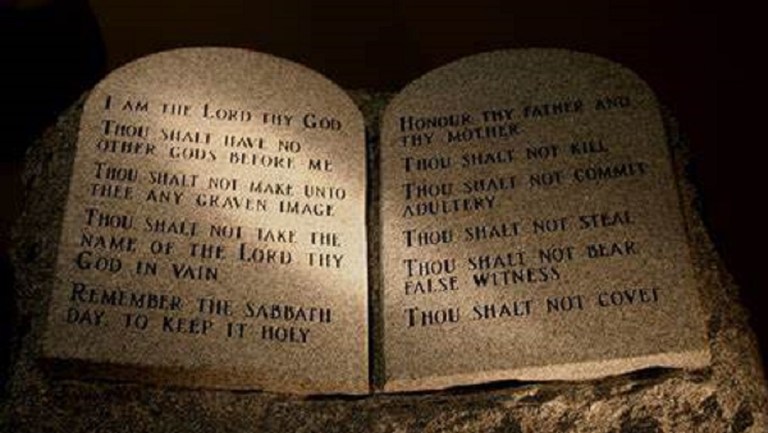
As you reflect on Chapter 5 this week, I want you to look at the 10 Commandments in what might be a new way.  Each one reveal something that we long for.  Something that we had in the Garden of Eden, something we were created to enjoy, that was lost because of sin.

Here’s what I mean:

We were created to worship the one true God – so we can have no other gods (commandment 1), even though we long to worship.

We were created to see God face to face – so we can’t make idols (#2), even though we long to see God.

We were created to chat with God as a friend in the cool of the day – so we can’t take his name in vain (#3), even though we long to speak to him.

We were created and long for rest, sabbath – and so we call “rest” holy.

We were created to be and long for a loving family, so we honour father and mother.

We were created to procreate, not take life, so we do no murder.

We were created to have trusting, committed, lasting partnerships, so we do no adultery.

We long for having all that we need, and were created to find all our fulfilment in God, but taking what isn’t ours got us into this mess, and so we do not steal.

And when we stole we lied about it, but we long for justice and truth, so we do not bear false witness.

And it all began because we wanted what wasn’t ours to take, we weren’t happy to trust what God had provided, and ever since we’ve longed to have more and more and more, but that longing can only be fulfilled by the One God who has it all, and that’s why we don’t covet.

Holiness is the reward

My friends, God calls us as we are, with all our weaknesses and hurts and longings; he calls us as we are to transform us into what we should be.

And the 10 Commandments are not a test – they’re the furthest thing from it. 

They’re our proper response.  Because we are holy, because we have been called and set apart to God’s glory, we will commit to live this way, because the 10 Commandments show us how the world was meant to be, what it was like before sin entered the picture, and give us a foretaste of what it will be like when all things are restored.

The 10 Commandments aren’t a path to holiness – no, they are a reward; living them is a glimpse of what life will be like when God makes all things new.

And, my friends, that glimpse isn’t for you.  Your life, living those 10 Commandments joyfully, reflects God’s light out into the darkness, drawing others in to see that there is a way for those longings are fulfilled: in God, Our Father, who calls each of us to be his own. 

To Him be the glory now and forever more. Amen.

True Thankfulness is Expressed as Trust.

The Story Chapter 4 (Exodus 1-7; 10-17)
2 Corinthians 9:7-11
Matthew 6:25-34

On this Thanksgiving Sunday, we’re called to express our gratitude for all that we have, and more importantly, we’re called to remember that it’s all a gift from God: all I have needed, thy hand has provided, right? 

But for me, as we go through our second Thanksgiving in a global pandemic, and having read together this weekend the remarkable story of God’s deliverance of his people from slavery in Egypt, I have to admit: I’m thinking a little differently about Thanksgiving this year. 

It’s easy to preach that Thanksgiving is about the virtue of gratitude.  But, I don’t know if it struck you like it struck me and my kids as we read Chapter 4, sometimes we just don’t know how thankful we should be.  Sometimes I know I find myself a lot like those Israelites – crying out to God for help, God responds, but instead of thanking Him and trusting in His plan, I find something else to complain about, and, like Jacob’s descendants being led out of Egypt, sometimes I maybe even wish that God hadn’t answered my prayer.

As they say, hindsight is 20/20, and that’s true in the Christian life as well. 

Just as the Israelites’ grumbling through the exodus becomes evident as we read it after the fact, self-awareness and recollection are God-given tools to open our eyes to the way He answers prayer.

Unless we stop to see how one prayer has been answered, we end up like those slaves, flip-flopping back and forth, praying for freedom, and then wishing they were slaves again; praying for God to protect and provide, but when He does, they respond by anxiously wondering who will protect and provide next time.

Trusting the God who Delivers

The first, and maybe the biggest point that should be jumping off the page as we read The Story together is this: God will make a way.

What we’re seeing is that God always keeps his promises.  The issue, though, is that we too often think his promises are for our personal gain.  Now I know some preachers have conned a lot of people and made themselves very rich by saying that God promises health and wealth and prosperity.  But you’ve read it: is that what God promises? 

God promises to crush the serpent’s head.  God promises to provide what we need.  God promises to use those who are obedient to His call to bless the whole world and reconcile them to himself.

No, God isn’t in the business of setting us up to depend on ourselves.  He told an old childless man squatting on someone else’s land in a tent that he would be the father of kings; he gave a young boy a dream that would protect his entire family, but only after he remained faithful through 20 hard years in a foreign land; and now He has indeed made Abraham’s descendants very numerous, thousands of people, but lest they depend on themselves, they find themselves in a foreign land, oppressed by a fearful king who is scared by how resilient this people is, even as slaves.

In that we see that God will always make a way.  But, especially at Thanksgiving, we have to accept that God’s not blessing us for our own benefit.  God blesses us to show forth his glory.  God blesses us so that all people will see and know that He is the Lord, that the God of Abraham, Issac, and Jacob is the Creator, who loves us enough to seek us out while we’re still sinful rebels, and desires nothing more than for us to turn from our wickedness and live to his glory.

God will make a way – but it’s always to his glory, and our response must always be to show the world how good he is.

Grumbling

The next thing that leaps off the page, though, is grumbling.  And grumbling is a lack of gratitude.

We all knew the Israelites grumbled in the desert, but until you read Chapter 4 this weekend, did you realize just how much they grumbled?  Eye opening, isn’t it!

But how often do we fall into the same boat? 

They wanted to be free, but they didn’t really want to be free.  They wanted their own land, but they missed how easy it was to get food and water when they were slaves.  They wanted God to lead them, but complained and wanted to turn back when He didn’t lead them in the direction they wanted to go.

As Paul said in our Epistle today, “God is able to make all grace abound to you, so that having all sufficiency in all things at all times, you may abound in every good work”. 

God will provide, but the good works we do with what he gives are up to us.

Will we take what God has given and give glory to his name?  Or will we gladly take what he has given, and then grumble because our hearts still aren’t satisfied? 

I’ve caught myself this week: for 18 months I’ve prayed daily that God would protect our town from this virus – and he has.  I’ve prayed daily that we would work together for the common good.  But have I praised him for his protection?  Or, instead, have I been quick to express my exhaustion and become a little complacent – which doesn’t serve the common good, and to find myself anxious as our case count begins to climb.

Jesus says, “do not be anxious about your life, what you will eat or what you will drink, nor about the body, what you will put on”.  If God has provided thus far, now’s not the time to question his provision and protection; now’s the time to work together for the common good as much as we did in the beginning, and most importantly, to give God the glory, because it’s in times like these, times when we learn that health and strength are gifts, that God uses you and me to draw our friends, families, and neighbours to Himself, that they too may trust in him and see his glory revealed.

God will make a way, but Grumbling is a lack of gratitude for the ways God has turned the world’s evil into good.

Faith in Action: Gumption

Instead, we need to have Gumption. 

Yes, putting our faith into action, whether it’s the exodus from slavery in Egypt, or the second thanksgiving in a pandemic, requires good old-fashioned gumption.  Perseverance, endurance, resourcefulness, initiative, imagination, wisdom, understanding, practicality, mettle, nerve, courage – all synonyms for good, old-fashioned gumption. 

Four chapters in – and each with a lifetime of experience – we know God is for us.  We know God provides, that he will work through whatever mess we’ve found ourselves in, if only we trust that his ways are higher than our ways.

But God expects our commitment.  He provides all we need, but then he expects us to follow through, to follow where he leads, whether that’s with a pillar of cloud and fire, a still small voice, or hiss promises patiently tucked away in our hearts.

Exodus tells us that God has a systematic way of dealing with the competition.  Those 10 plagues aren’t random – each plague is set against one of the false gods of the Egyptians, as their gods of the Nile, of crops, of livestock, of medicine, of fertility, of the sun, and of procreation are all proven to be subject to God Almighty. 

And so, part of our Thanksgiving recollection must be asking ourselves: what false gods do we worship? 

Where do we place our trust?  In the economy?  In our ability to work?  In democracy and good government?  In self-sufficiency and individual rights and freedoms?  In the pride of believing that all that we have comes from our selves? 

It’s worth thinking about, because we know God is in the business of casting down false idols, and in my own life, as I wander through this pandemic time, I see God calling me to turn away from all those good things in which I put too much trust, and to instead trust him with gumption, to trust him boldly, knowing he’s going to reveal his glory, and he’s going to provide for my every need, if I follow him in faith.

True Thankfulness

I want to leave you with this observation.  I’ve always limited “thankfulness” to gratitude, to stopping to say “thank you” for what I’ve received. 

But as I’ve read chapter 4 this week, I think there’s more to it.  Taking a break to say thank you isn’t what God desires.

True thankfulness is expressed as trust. 

True thankfulness is trusting that God will make a way, as he has before.

True thankfulness is giving up on grumbling, and trusting that God knows best.

True thankfulness is having the gumption to say “all I have needed, his hand has provided”, so I will go where he leads me, because he will never forsake me, his grace is sufficient for my weakness, and he will finish what he started.

True thankfulness is expressed as trust.  And may God give us the grace to be truly thankful.  Amen.

Vocation: What are you building?

The Story chapter 3
Genesis 37:2-8
Hebrews 11:17-22, 39-40
John 14:1-3, 18-20

Once upon a time, there were 3 stone masons.  They were working side-by-side, doing the exact same work, with the hot summer sun beating down upon their backs, and their heads swarmed with flies.

You ask the first one: “what are you doing?” 

            “Laying bricks in the burning sun.”  And that’s true.

You ask the second one: “what are you doing?”

            “I’m building a strong wall, to protect against the elements.”  And that’s true, too.

You ask the third one of these same men, standing side by side, doing the same work, “what are you doing?”

            He replies, “I’m building a cathedral to the glory of God.”  And he is.

As you’ve read this weekend the tangled story of Joseph, I want us to think about our vocation, and how we live to God’s glory in the world.

Vocation in the Story of Joseph

We’ve been raised to think of “vocation” as ‘what you do for a living’.  But that’s only partially true.  Up until the late 1800s, vocation was an entirely religious word, and I think the Church would do well to keep that in mind. 

 “Vocation” comes from the Latin word “vocare”, which means “to call”.  It’s the word used throughout Church history to speak of those who are called to any work or ministry for God, done in, with, and through the Church as the community of the faithful, whether that’s preaching the Gospel, raising kids, or washing dishes and waiting on tables. 

Every person, made in the Image of God, is called – has a vocation – to live to God’s glory in the world. 

And the point of saying that everyone from the business person or landlord to the cashier or retiree has a vocation is this: vocation isn’t about what is done, it’s about how you do it.

Vocation is about perspective.  It’s about being willing to trust in the Master Builder’s plan; even when, as the hot sun beats down on our backs, it looks like all we’re doing is laying bricks.  It’s a statement of faith that, though I may not live to see it, and though there are real, painful, and lasting consequences for greed and impatience and pride in the world, yet God will keep his promises. 

A Matter of Intention

The key phrase for me in all of Chapter 3 came right at the end.  It’s Genesis 50, verses 19-20.  Joseph, who was sold as a slave by his jealous brothers, now finds himself as a prince over Egypt, second only to the Pharoah on the throne.  And those same jealous brothers are now fearful that, as a final act in his old age, Joseph will get his revenge.  Just as Joseph dreamed as a boy, now his brothers bow down before him, offering themselves as slaves to the one they sold as a slave.  But what does Joseph say?

“Don’t be afraid…  You intended to harm me, but God intended it for good…, to accomplish the saving of many lives.  Don’t be afraid”.

It’s a delicate message, and we have to balance it carefully.  No, everything doesn’t happen for a reason.  That’s ridiculous. 

  • Did God intend for Abraham’s offspring to be dysfunctional?  No.
  • Did God intend for brothers to be jealous of each other? No.
  • Did God intend for the Ishmaelites – whom you now know to be Joseph’s cousins, as Ishmael and Issac both came from Abraham – to be slave traders and purchase the son of their second cousin?  Not at all.
  • Did God intend for Potiphar’s wife to be a lustful, adulterous liar?  Certainly not.
  • Did God intend for there to be a drought?  No, you remember that, at the beginning, God intended for people to live in a perfect relationship with Creation providing food freely from the ground.

The message isn’t “everything happens for a reason”.  The only ‘reason’ behind any of this is sin!

No, the message is this: what the world, the flesh, and the devil intended for evil, God intends for good.  Or, we can take heart in what Paul writes to the Romans: No, the world is not as it ought to be, “but God works all things together for the good of those who love him and are called according to his purpose.”(8:28)

We all share that calling, that vocation.  But how do we live it?

Joseph as an example.

I want to suggest that in Joseph we see three ways we are called in a broken and twisted world; three ways to live with God’s big plan as our perspective, to trust that we are building cathedrals, not just laying bricks.

First: we must be willing to do the work we’ve been given to do.

Now, let me be very careful.  I’m not saying “bloom where you’re planted”.  That’s another religious-sounding phrase used to keep Christians from using their gifts.

I’m saying the opposite.

When God has given you a gift, you have to assume it’s not for your sake.  Many parts, one body, right?  Joseph had the gift of the Holy Spirit to be a prophet, yet he was born into a family of wandering shepherds. 

Joseph could have had an easy, happy life, tending flocks, moving the herd from pasture to pasture, all he had to do was keep his mouth shut.  It would have been an easier life… at least until the famine came.  And then just imagine the guilt and shame that would have come, as Joseph watched his family starve and he knew he was receiving visions from God, but chose to keep them to himself. 

No, we must do the work we’ve been given to do.

There’s no such thing as unemployment in the kingdom of God.  There’s only under-employment, not using our gifts; being happy laying bricks, being happy as a slave in the field when God has planted a vision of his bigger plan, and has called us to work towards that vision of a redeemed humanity.

Not that we all need to be rulers of Egypt.  Washing the dishes and making your loved ones a meal can be great if it’s done to the glory of God.  But each of us are invited to be part of God’s Upper Story, the unfolding of his great plan, and we need to share that vision, share that understanding of how each action plays out in our lives day-to-day.

And, in that, we learn from Joseph that we must have character. 

Everyone around Joseph was lying.  There was jealousy, there was adultery.  There’s the heartbreaking story of God’s chosen patriarch, Jacob, living a life weighed down by grief as 11 of his sons conspired against their father, unwilling to come clean about what happened that day in that field.

But Joseph showed integrity – and we should note, he even showed integrity when it made no sense, when any reasonable person would say “just keep your mouth shut”, he wasn’t willing to compromise, even when it cost him dearly.  And, because of that, we hear that God was with him, whether as a slave, or thrown in prison, or as ruler of Egypt.

And finally, Joseph reminds us that sometimes we have to run away.

I’ll remind you that standing firm in the wrong place is the opposite of the Christian life.  Yes, we’re to stand firm in faith, but the life of repentance is a whole life of turning around, of changing direction, of realizing you’re not where you should be.

It’s nice to cling to those couple of verses that tell us to stand firm… but how many more times does scripture tell us to flee what is wrong?  When Joseph realized what Potiphar’s wife had in mind, it was like a Bugs Bunny cartoon – he took off so fast that his cloak fell off!

Joseph knew he was created in the Image of God, to reflect God’s glory, to inherit God’s promises to redeem a fallen world, and he was ready to change course and run the opposite direction – even if it meant prison time – rather than compromise his own beliefs and integrity.

What are we building?

My friends, what are you building?

Are we going about our days, labouring, toiling, wearing ourselves down laying bricks?  Or, have we caught the vision for what God is doing in the big picture?

I can guarantee that the experience and the blessing of even the most unpleasant tasks will be entirely different when you come to see that, yes, you are part of God’s big plan.

You may never see it.  You may never see my grandkids freed from addiction and broken relationships.  You may never live to see that broken home restored, you may never see how that one word of truth or honesty spoken in the checkout line at Kaeser’s might be a word from God that changes a family for generations to come. 

But, if I recognize that, yesterday, today, and forever, our God is in the business of reaching out, that even now, Jesus is building a mansion with many rooms for you and for me, that big-picture perspective unlocks your vocation here and now. 

What the world intends for evil, God intends for good.  And he invites you to be a part of that, and all for his glory.  May God give us grace to serve him faithfully in the world.  Amen.

God Builds a Nation

The Story chapter 2, Genesis 12-36

Genesis 12:1-3; 15:3-6
Galatians 3:16-18, 27-29
Mark 3:31-35

Last week, we saw that, in God’s unchanging “Upper Story”, a good God created a good creation where people made in His Image enjoyed beautiful, healthy relationships with God the Holy Trinity, with each other, and with all of creation. 

But, because no relationship can be forced, there’s the possibility that we can say no.  And when we did, what did we find?  Sin changes everything.

But as we read Chapter 2 this weekend, we see another aspect of God’s eternal plan revealed to us: what sin changes, only faith overcomes.

Our relationship with God was severed by sin, and there’s no way to get that back – no amount of sewing fig leaves or making sacrifices or doing good deeds can undo what was broken.  There’s no way to get it back… except by faith.

We were created to be a family – brothers and sisters, children of God Our Father.  But, our relationships with each other were destroyed, utterly broken by blame and jealousy and envy, picking sides and choosing favourites, lying, cheating, and stealing to the point where no one can trust another.  And there’s no way to get it back… except by faith: by the faith to actually believe and live as though we are brothers and sisters, children of Our Heavenly Father.

And we were created to be in relationship with creation, to rule over it in the same way that God lovingly rules over all things.  But instead, we war against creation, and our bodies bear the consequences as we wear out and return to the dust from which we were made.  But there is a way to overcome that broken relationship with creation, to find re-created and restored life beyond the grave.  And what’s the only way to get that back? By faith!

Yes, God’s grand story shows us that what sin changes, only faith overcomes.

God Wills to Build a Nation

In Chapter 2 you read the story of Abraham, the one through whom God would build a nation – a holy nation.

But it’s a surprising story, isn’t it?  Maybe you’ve been taught (through Sunday School songs about “Father Abraham” and his many sons) to see Abraham as a great and mighty figure, the patriarch over God’s chosen kingdom.  But when you actually read it all laid out, it’s not that simple, is it?

We often think of faith as something we choose: the choice to be here this morning, the choice to repent of our sins and see ourselves through God’s eyes, the decision (as the song says) to “follow Jesus” (no turning back, no turning back).  But those are all responses.  The eternal, unchanging truth that we see in Abraham is that God reaches out; God calls out to each and every one of us first.

God offers us faith; we then decide if we will allow that faith to fill us: if we want to be faith-filled, faith-full.

God calls us.

And the glorious truth we see in Abraham is that God’s purposes, God’s desire, God’s covenant is not conditional.  We don’t often stop to think in these terms.  But God doesn’t say “if you will follow me I will make you a great nation.”  He doesn’t say “if you will follow me, the whole world will be blessed through your line”.  He doesn’t say “if you will follow me, I will send my Son to take flesh through your descendants so that sin and death can be defeated.”

No.  What does God say?  God says, “I will.”  God calls Abram and reaches out with the gift of faith, because God has a plan – the same plan from the beginning.  Abram just has to choose how he will respond; will he spend his life being fueled and filled by that faith, or will he spend his days running from and fighting against the relationship that God desires?

And God is the same yesterday, today, and forever. 

There’s not a single person who isn’t made in the Image of God, created to reflect His glory, and share in the life and love of the Trinity.  There’s not a single person you know whom God isn’t calling, whom God isn’t offering that gift of faith.  The question is whether they, whether we, say “yes, fill me.  I want to be full of faith, I will, I choose to be faithful”, or whether we run from that call and go our own way.

God calls Abram, and God’s decision is to use Abram to make for himself a holy people, a nation through whom the rest of humanity can see God’s glory, and be saved from sin by the gift of faith.

Drawn Together for a Purpose

In that we see another big, universal, unchanging truth.  God calls us individually, but not for our own sake

And that’s a hard idea, because sin changed everything.  Sin made us individualistic; we were created for relationships with God, others, and creation, to be part of something much bigger.  So when God calls each of us, it’s not so we can be glorified individuals.  He calls us, and his purpose is to restore those relationships; not just so I can be holy and I can live forever, but that I can be part of a holy people that lives forever in relationship, reflecting the Image of God to each other, and the glory of God back to the source of life and light Himself.

God calls us, he offers the gift of faith, and he’s drawn us together for a purpose.

But it’s the choice, that response, that desire to be filled by faith – to be faith-full – or not, that changes how it plays out.

It’s a fabulous calling… but how did it work out for Abraham and this chosen family?

  • Scripture tells us Abraham picked up and moved alright, but He didn’t quite trust that God would protect his life, and lied twice, saying his beautiful wife was his sister for fear he’d be killed.
  • He didn’t quite trust God would do what seemed impossible in his wife’s old age, so he went to bed with his maid.  And Sarah gets jealous to the point that the maid and her son are sent out into the desert with nothing but some bread and water.
  • Issac, the promised child, finally comes, and there begins the story of a dysfunctional family of epic proportions.  Mom has a favourite kid, Dad has a favourite kid, and the two play off each other with elaborate hoaxes to trick one into inheriting God’s blessing. 
  • Jacob gets the blessing, but is afraid his brother wants to kill him, so he runs away from all that he inherited – only to fall in love with his first cousin… except then his uncle tricks him, so he ends up marrying not one, but two of his first cousins.
  • He finally patches things up with his brother, and goes on to have a dozen kids of his own… but what does he do?  Well, this child of promise follows in his parents’ footsteps, and picks a favourite son again!  How does that play out?  As you’d expect!

God made a decision; God made an unbreakable promise; God had a purpose to bless all of humanity through Abraham’s family line. 

Did he do that because Abraham was the best choice?  Because he was strong and mighty?  Because he had built himself a nice empire in a good land?  Because he was patient and had good child-raising skills?  No, not at all.

Not at all.  This family was a total mess.  Sure, Abraham wanted to be filled-with-faith, to be faithful, but if you want to see the effects of sin in a human life, look at Abraham, look at Isaac, look at Jacob!  Yes, God called Abraham, but we overlook that between Genesis 12 and Genesis 23, God calls Abraham 10 times, because Abraham needs it! And Jacob, who is to become the patriarch of all Israel, just can’t understand God’s grace until God finally wrestles him to the ground and pins him with his hip out of joint.  Then he understands God’s grace… only to go and play favourites with his sons, repeating his own parents’ failure.

The point is this: God uses broken people to fulfill His unbreakable promises.

It’s the idea in one of my favourite “motivational” posters: “when God put a calling on your life, He already factored in your stupidity”.  It sounds harsh… but read your Bible!  It’s true!

Not so different from ourselves.

But… God called them.  And he called that family for a purpose, drawing them together for a purpose.

And, because God is unchanging, the same is true for us.

God called a man, took him away from any chance he had for worldly power in his hometown, told him he would have countless offspring and be the great-grandfather of kings… and sent him to live in a tent as a squatter on someone else’s land.  God doesn’t call the equipped, he equips the called.

And, seriously, look around.  We’re the inheritors of that promise.  We, along with our brothers and sisters at the Pentecostal and Roman Catholic churches,are the ones through whom all of Fort Smith is to be blessed and called back into relationship with God.

But look at us.  We’re a lot like Abraham!  We’re a congregation that’s past childbearing years; most of us are retired, we don’t have influence or worldly power.  Every time I hold an event, even yesterday, someone who has been in town for years said they had no idea we were here.  Like Abraham’s family, we’re richly, richly blessed, but in the eyes of the world, we’re ‘small, and of little account’.

But God has called us.  God made a decision.  God has said “you are my son; you are my daughter; I am your Father”. 

And he calls us and equips us individually, but not for our own sake.  We are children of Abraham’s promise; we have inherited by adoption God’s blessing to Abraham – yes, you are the one through whom God wants to bless the world and draw all people to himself. 

…And that sounds ridiculous, but believe me, it’s no more ridiculous than telling an old man in a tent that he’s going to be the father of kings; and whatever you’ve done, however you’ve been unfaithful, you probably haven’t pretended your wife was your sister, slept with your maid because you were impatient with God, and sent your mistress and son to wander in the desert, so believe me, if God can use Abraham, God can use you.

Because the bottom line is this: God’s calling is not dependent on our performance.  God offers faith.  Our job is to decide if we want that faith to fill us, if we will and desire to be faith-full.

My brothers and sisters – for that’s what we were created to be – sin changes everything.  But what sin changes, faith overcomes.  And, by faith, it’s through you that God wants to bless the world with eternal life.

May God draw us ever closer, and equip us for the work he’s given us to do.  Amen.